Best Mini Tiller for Homeowners: TaskStar Leads

Five mini tillers compared on tilling width, depth, weight and warranty, with the TaskStar cordless leading on runtime and the Honda FG110 taking the premium pick.

By Dane JonesUpdated 14 min read
On this page
- Best mini tiller for homeowners at a glance
- Who this guide is not for
- 1. TaskStar Cordless Tiller Cultivator — Best overall
- 2. Honda FG110 Mini Tiller Cultivator — Best premium
- 3. EWORK 20V Cordless Tiller Cultivator — Best budget pick
- 4. Earthquake 31635 MC33 Mini Tiller Cultivator — Most versatile
- 5. Mayoki Battery Powered Garden Tiller — Best upgrade
- How I screened the shortlist
- What actually decides a mini tiller
- Cordless or gas: which suits your yard?
- How wide and deep do you really need?
- What the listings do not tell you
- The verdict
- FAQ
The best mini tiller for homeowners is the TaskStar Cordless Tiller Cultivator, a 10.6 lb battery unit that ships with two 20V 4.0Ah packs and a 360 RPM motor. If you want a four-stroke gas engine and a two-year residential warranty instead, the Honda FG110 is the pick, at 28 lb with a 9-inch tilling width that drops to 6 inches when you pull the outer tines. Everything below is drawn from the published listings, side by side.
Best mini tiller for homeowners at a glance
| Pick | Tilling width | Weight | Warranty | Price |
|---|---|---|---|---|
Best overall TaskStar Cordless Tiller Cultivator |
9 in claim | 10.6 lb claim | Not listed | Check Price |
Best premium Honda FG110 Mini Tiller |
9 in, 6 in with outer tines removed | 28 lb | 2-Year Residential | Check Price |
Best budget pick EWORK 20V Cordless Tiller |
9 in claim | Not listed | 1 year | Check Price |
Most versatile Earthquake MC33 Mini Tiller |
Not listed | 29 lb | 5-Year Limited | Check Price |
Best upgrade Mayoki DeWalt-Compatible Tiller |
10 in claim | Not listed | Not listed | Check Price |


Who this guide is not for
Mini tillers cultivate soil. They do not turn hardpan into topsoil on the first pass, and they are not a substitute for a rear-tine tiller when you are breaking new ground. A mini tiller is a maintenance tool for beds you have already worked at least once.
The five picks here are all mini or hand-held cultivators, and every listing describes garden beds, raised beds and small plots. If your project is a fresh quarter-acre plot in rocky or heavily compacted clay, none of these is the right answer. Rent a walk-behind tiller for the first pass and use a mini tiller like these for every pass after.
A note on the modifier. Amazon's search returned a mix of homeowner and small-farm tools rather than a strict homeowner-only list, so treat "for homeowners" as your own filter rather than a promise Amazon enforces. Match the picks to your bed size, your storage space and your tolerance for fuel, and you will get more out of this shortlist than the search bar can give you.
1. TaskStar Cordless Tiller Cultivator — Best overall
The best mini tiller for homeowners overall, because it pairs the lowest weight in the set with the largest advertised battery pack.
Best for: raised beds and small vegetable plots under a quarter acre Skip it if: you need to break virgin sod or clay-heavy ground
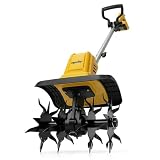
TaskStar publishes a 10.6 lb weight in its feature bullets. That is roughly a third of the Honda FG110's 28 lb and the Earthquake MC33's 29 lb, and it is the figure that decides who this tiller is for. If you cannot comfortably wrestle a 29 lb gas machine around a corner of a raised bed, this one solves the problem.
The listing describes a 360 RPM high-torque motor and two 20V 4.0Ah lithium batteries. Two 4.0Ah packs is the largest battery kit named in this shortlist, and it matters because tilling drains a battery faster than most yard tools. TaskStar also says the main handle adjusts for height and there is a front auxiliary handle for control.
What the listing does not publish is a warranty, and the head unit is compact at 7 x 7 x 4 in, which suggests a narrower path than a walk-behind. This is a bed tool, not a plot tool. Against the gas picks it gives up raw power; against the other battery picks it gives up nothing on runtime.
Pros:
- Lightest published weight in the set at 10.6 lb
- Two 20V 4.0Ah batteries included per the listing
- 360 RPM motor claim from the manufacturer
- Adjustable main handle plus front auxiliary handle
- Mid price position, not premium
Cons:
- No warranty published on the listing
- Only one seller lists it
- Compact head suits beds, not large plots
- No published tilling depth figure
2. Honda FG110 Mini Tiller Cultivator — Best premium
The premium pick in this set, because it is the only four-stroke gas tiller with a published two-year residential warranty.

Best for: buyers who want a four-stroke engine and a two-year warranty Skip it if: you want to avoid gas, oil and pull starts
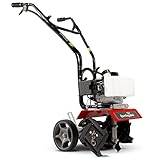
The FG110 is the most expensive pick here, and the specifications explain the position. Honda names its GX25 four-stroke engine, which runs on straight gasoline rather than a two-cycle oil mix. That is a real quality-of-life difference against the Earthquake MC33's 2-Cycle Viper engine, which needs pre-mixed fuel.
The published dimensions are 16 x 25 x 23 in and the weight is 28 lb, with two-position transport wheels called out in the feature bullets. Tilling width is 9 in with the regular tine layout, and Honda says removing the outer tines drops it to 6 in for tight spots. An adjustable depth bar controls how aggressively the tines dig. The warranty is 2-Year Residential.
The trade-offs are the ones gas always brings. You will store fuel, you will pull-start it, and you will maintain a small engine. Against the battery picks it gains sustained power and loses convenience. Against the Earthquake it gains a cleaner fuel routine and a simpler start, and loses three years of warranty coverage.
Pros:
- Four-stroke GX25 engine, no fuel mixing
- 9-in and 6-in tilling widths from the same tine kit
- Two-Year Residential Warranty published
- Two-position transport wheels listed
- Adjustable depth bar for pass control
Cons:
- The most expensive pick in the set
- 28 lb, heaviest tier alongside the Earthquake
- Only one seller lists it
- Gas storage and pull-start routine
3. EWORK 20V Cordless Tiller Cultivator — Best budget pick
The cheapest pick in the set, and the only one with two sellers listed.

Best for: first-time buyers testing whether a tiller earns its shed space Skip it if: you already own a 20V tool platform you want to reuse
EWORK sits at the entry price position, so it is the pick when you are not sure how often you will actually use a tiller and you do not want to commit heavily. The feature bullets describe a 9-inch tilling width and a 7-inch working depth, and two 20V 2.0Ah lithium batteries with a fast charger.
Those 2.0Ah packs are half the capacity of the TaskStar's 4.0Ah packs, so plan on shorter working sessions between swaps. For a couple of raised beds and a few borders, that is fine. For a longer session in dense soil, you will notice the difference. The warranty field on the listing shows 1, which reads as one year, and the published dimensions of 48.4 x 22.8 x 15.8 in suggest a longer-handled machine than the compact TaskStar.
Against the Mayoki, EWORK includes batteries and a charger in the box; Mayoki does not. Against the TaskStar, EWORK gives up battery capacity. Against the gas picks it gives up power and gains silence, weight and a plug-in charger routine.
Pros:
- Cheapest pick in the set
- Two 20V 2.0Ah batteries and charger included
- 9-in width and 7-in depth per the listing
- Two sellers stock it
- Slim frame with anti-slip grip claim
Cons:
- Only 2.0Ah packs, half of TaskStar's capacity
- Warranty published as 1 without further detail
- No published weight figure
- Sells slower than the top picks here
4. Earthquake 31635 MC33 Mini Tiller Cultivator — Most versatile
The most flexible pick for weeding, mixing and aerating, backed by a 5-Year Limited Warranty.

Best for: mixed yards that need weeding, aerating and light row work Skip it if: you prefer battery tools and dislike mixing two-cycle fuel
Earthquake pitches the MC33 as a do-many-things machine, and the published warranty tells you the manufacturer is willing to stand behind that pitch for five years. That is the longest warranty in this shortlist by a wide margin, and it is the strongest single reason to look at this pick.
The listing names a 33cc 2-Cycle Viper engine, a gear-drive transmission and height-adjustable wheels. Published weight is 29 lb and dimensions are 40 x 18 x 33 in, which puts it in the same size and weight class as the Honda FG110. The overhand control layout is called out for reducing bouncing when you are working close to plants you want to keep.
The trade-off is fuel. Two-cycle engines need a gasoline and oil mix in the right ratio, and getting that wrong is how small engines die young. This is the slowest seller of the five here, and the tilling width is not published on the listing, so you are relying on Earthquake's category positioning rather than a printed number.
Pros:
- 5-Year Limited Warranty, longest in the set
- 33cc Viper engine claim for tougher soil
- Gear-drive transmission called out on the listing
- Height-adjustable wheels for depth and transport
- Overhand control layout for row work
Cons:
- Two-cycle fuel mixing required
- No published tilling width figure
- Sells slower than the rest of this set
- Premium price position
5. Mayoki Battery Powered Garden Tiller — Best upgrade
The upgrade pick if you already own DeWalt 20V MAX batteries, because it is the only tool-only unit here.
Best for: DeWalt 20V MAX owners who already have batteries on the shelf Skip it if: you do not own DeWalt batteries and do not want to buy in
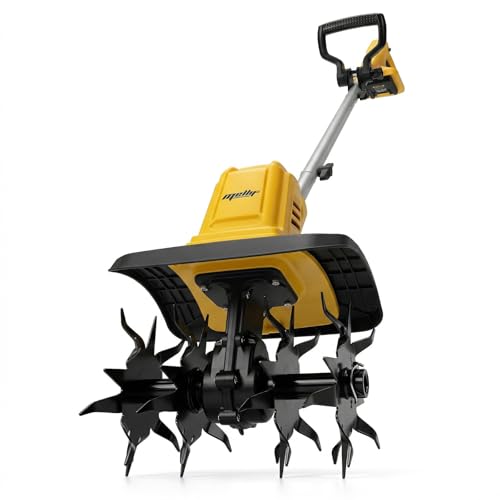
Mayoki sells this as a bare tool that runs on DeWalt 20V MAX packs, and the listing is explicit that the product is not affiliated with DeWalt. If you already own that battery platform, this is the cheapest way into a battery tiller in the set once you subtract the batteries you do not need to buy.
The feature bullets publish a 280 RPM brushless motor, a 10-inch tilling path, a 7-inch cultivation depth and 48 staggered steel tines. The 10-inch width is the widest cordless claim in this shortlist, and the brushless motor is a durability point over the brushed motors implied elsewhere. A 180-degree adjustable auxiliary handle and a safety lock switch are also called out.
The catches are honest ones. No batteries are included, no warranty is published on the listing, and no weight is published either. The entry price band reflects the tool-only kit, so budget the battery when you compare. Against the TaskStar you gain a wider tilling path and a brushless motor and give up an included battery kit.
Pros:
- Runs on DeWalt 20V MAX batteries per the listing
- 10-in tilling path, widest cordless claim here
- Brushless motor at 280 RPM claim
- 48 staggered steel tines called out
- Entry price position as a tool-only kit
Cons:
- No batteries or charger included
- No warranty published on the listing
- No published weight figure
- Locks you into one battery platform
How I screened the shortlist
Three reasons cut listings from consideration, and what survived is what you see above.
- Full-size rear-tine tillers were out. This roundup is the best mini tiller for homeowners, so anything over roughly 40 lb with a walk-behind frame was set aside for a different guide.
- Corded electric tillers were out. A cord is a real constraint when you are working around beds, hoses and children, and it puts a corded machine on a different comparison than gas or cordless.
- Listings with missing core data were out. If a listing did not publish either a tilling width, a weight, or a battery figure, it could not be compared honestly against the rest.
The five that survived split evenly on power source. Three cordless picks, TaskStar, EWORK and Mayoki, use 20V lithium platforms. Two gas picks, Honda and Earthquake, use small four-stroke and two-cycle engines respectively. Every pick here is described in its listing as compact, mini or hand-held.
What actually decides a mini tiller
Most guides compare engine displacement or motor voltage. That is not what decides it. Tilling width and depth, matched to your bed size, decide it. A 9-inch head passes twice through a 3-foot bed and you are done; a 6-inch head passes three times.
Depth matters more than most buyers expect. The two picks that publish depth figures, EWORK and Mayoki, both claim 7 inches. That is enough to work the top layer where roots and weeds live, and not enough to break a fresh compacted plot on the first pass. If your soil is virgin ground or heavy clay, you are renting a rear-tine tiller for the first pass regardless of which mini you buy.
Weight is the third axis, and it decides how tired you are at the end. TaskStar's 10.6 lb versus Honda's 28 lb and Earthquake's 29 lb is a real gap, and it is the reason the cordless pick tops the list for typical homeowner beds.
Cordless or gas: which suits your yard?
Cordless suits smaller, tidier jobs where you value silence, no fuel and easy starts. Gas suits longer sessions, denser soil and buyers who already service other small engines. The line runs roughly like this:
- Under a quarter acre of beds: cordless. TaskStar's two 4.0Ah packs will get you through most days.
- Quarter acre to half acre of mixed beds and rows: gas. Honda's four-stroke is the friendlier of the two engines here.
- Regular weeding across a mixed property: gas with a long warranty. Earthquake's five years is the standout.
- You already own DeWalt 20V MAX: cordless, tool-only. Mayoki is the pick and it undercuts buying a kit.
The real switching cost people miss with cordless is battery replacement three or four seasons in. Factor in a spare pack from the start.
How wide and deep do you really need?
Match tilling width to your narrowest working path. The Honda FG110 is unusual because you can drop it from 9 in to 6 in by pulling the outer tines, which turns one tool into two. The Mayoki claims the widest cordless path at 10 in.
Depth is simpler. Seven inches, which EWORK and Mayoki publish, is enough for annual bed prep, compost mixing and shallow weeding. If you need to break new ground, no mini tiller in this set is your first-pass tool.
Two quick reference points from the shortlist:
- Widest published tilling path: Mayoki at 10 in claim.
- Narrowest configurable tilling path: Honda FG110 at 6 in with outer tines removed.
What the listings do not tell you
Three things do not appear in any of the five listings, and they matter.
- Real runtime under load. Battery figures are capacity, not minutes. Two 4.0Ah packs will outlast two 2.0Ah packs, but the exact minutes depend on soil and pass depth.
- Noise. None of the listings publish a decibel figure. Assume gas is louder than cordless and plan hours accordingly if you share a fence line.
- Serviceability. Only Honda and Earthquake name warranty length; only Earthquake mentions US-based support. Cordless picks tend to be replace-rather-than-repair.
Add a small notebook to your first season: dates, hours, batteries used, weather. By year two you will know exactly which tiller in this shortlist you should have picked, and you will save an hour every session by planning around your real runtime instead of the listing's headline number.
The verdict
The best mini tiller for homeowners is the TaskStar Cordless Tiller Cultivator for buyers with beds under a quarter acre and a preference for battery tools. At 10.6 lb with two 20V 4.0Ah packs and a 360 RPM motor claim, it is the lightest and the best-provisioned cordless pick in this set, and it sells faster than any of the other four here.
Two tracks flip the recommendation. If you want gas power with a four-stroke engine and a published two-year warranty, buy the Honda FG110. Its 9-in and 6-in tilling widths from a single tine kit, plus a proper depth bar, make it the more capable machine in denser soil, at the cost of 28 lb of weight and a fuel routine. If you already own DeWalt 20V MAX batteries, buy the Mayoki tool-only unit and skip the kit price entirely; a 10-in tilling path and a brushless motor are strong specifications for the entry price position.
The cutoff between the tracks is roughly a quarter acre of active beds. Below it, cordless is the honest answer. Above it, or in heavier soil, gas earns its weight.
FAQ
Is a mini tiller worth it for a small yard?
A mini tiller is worth it for a small yard when you have at least two or three beds you turn each season. For a single 4x8 raised bed, a hand fork does the job. Once you are past three beds, or you are mixing compost into borders each spring, a 9-in or 10-in cordless mini like the TaskStar saves real time and back strain.
Which mini tiller has the longest warranty?
The mini tiller with the longest warranty in this shortlist is the Earthquake MC33, which publishes a 5-Year Limited Warranty on its listing. The Honda FG110 publishes a 2-Year Residential Warranty. EWORK's listing shows 1, which reads as one year. TaskStar and Mayoki do not publish a warranty figure, so you are relying on the seller's return window instead.
How wide is the TaskStar cordless tiller?
The TaskStar cordless tiller lists a size of 9 in x 6.6 in on its specifications and describes a compact 7 x 7 x 4 in unit. The listing frames the machine around soil preparation for beds rather than long garden rows, and pairs the head with a 360 RPM high-torque motor claim and two 20V 4.0Ah lithium batteries for extended runtime.
TaskStar or Honda FG110 for a home garden?
TaskStar or Honda FG110 depends on soil and body. Pick the TaskStar if your beds are already worked, you value 10.6 lb over 28 lb, and you want cordless with two 4.0Ah packs. Pick the Honda FG110 if your soil is denser, you want a four-stroke engine on straight gasoline, and the two-year residential warranty matters more than saving twenty pounds of carry weight.
What is the biggest mistake buying a mini tiller?
The biggest mistake buying a mini tiller is expecting it to break virgin ground. Every pick in this shortlist is a cultivation tool for beds you have already worked. Ask a mini to tackle compacted sod on its first pass and you will burn out tines, drain batteries and blame the machine. Rent a rear-tine tiller for the first pass, and use a mini for every pass after.
Five listings, five different trade-offs, and no single pick that wins every argument. If you are still weighing the shortlist, start with your bed count and your storage space rather than horsepower or voltage. A tiller that lives on a hook and comes down twice a season for raised beds is a different tool from one that lives on the garage floor and works a mixed property every weekend. The TaskStar earns the default because most homeowner beds are small, most homeowner backs prefer 10.6 lb, and most homeowner sheds are already crowded. Match the tool to how you actually garden, and this decision is quick.