Best Walk Behind Garden Tiller by Width and Depth

Five walk behind garden tillers compared on width, depth, engine and weight, with the buyer profile each one actually fits and the trade-offs the listings do not spell out.

By Dane JonesUpdated 15 min read
On this page
- Best walk behind garden tiller at a glance
- How I screened the listings down to five
- 1. Baotree 4 Stroke Gas Tiller Cultivator — Best overall
- 2. Sun Joe Corded Electric Garden Tiller & Cultivator TJ604E — Best upgrade
- 3. EEYBLAEEY Gas Powered Mini Tiller and Cultivator — Best budget pick
- 4. Echo TC-210 9 in. 21.2 cc Gas Tiller/Cultivator — Best premium
- 5. OMMUNICT 63CC Walk Behind Brush Cutter — Best minimal setup
- Width and depth: the specification that actually decides it
- Gas or corded electric for a home garden?
- What the product listings do not tell you
- Which tiller fits your plot?
- The verdict
- FAQ
The best walk behind garden tiller for most home gardens is the Baotree 4 Stroke Gas Tiller Cultivator, which pairs a 20 in working width with a 10 in maximum depth from a 1.5 kW engine. The Sun Joe TJ604E is the better buy if you can reach an outdoor outlet, because its 13.5-amp corded motor skips fuel and oil entirely while still cutting a 16 in path 8 in deep. Choice of walk behind garden tiller comes down to how wide and deep you actually need to cut, and how far you are from a wall socket.
Best walk behind garden tiller at a glance
| Pick | Working width | Max depth | Price |
|---|---|---|---|
Best overall Baotree 4 Stroke Gas Tiller Cultivator |
20 in claim | 10 in claim | Check Price |
Best upgrade Sun Joe TJ604E Corded Electric Tiller |
16 in claim | 8 in claim | Check Price |
Best budget pick EEYBLAEEY 52cc Mini Tiller |
~14 in claim | 4 in claim | Check Price |
Best premium Echo TC-210 Front-Tine Gas Tiller |
9 in | not listed | Check Price |
Best minimal setup OMMUNICT 63CC Walk Behind Cultivator |
not listed | not listed | Check Price |


How I screened the listings down to five
I started with everything Amazon returns under Outdoor Power Tools that a person actually walks behind, then cut anything the listing could not describe with a working width, a depth figure, or an engine rating. That eliminated a wide layer of hand-held mini cultivators dressed up in tiller language.
From what was left, I lined up the five picks so they cover the real spread of plots a home gardener has to work:
- A wide gas machine for open ground.
- A corded electric for smaller suburban gardens.
- A budget gas mini-tiller for beds and borders.
- A narrow premium gas cultivator for tight rows.
- A multi-purpose walk behind for mixed yard work.
Two things I refused to guess at. Where a listing does not publish a depth figure, I did not invent one, and the table shows it. Where a manufacturer feature bullet makes a performance claim, the pick section attributes it rather than repeating it as measured fact.
The keyword phrase carries "garden" as a qualifier, but Amazon's category placement is inconsistent across these five: one sits under walk-behind mowers, another under industrial motors. Treat the category badges on Amazon as loose, and judge each machine by width, depth and engine instead.
1. Baotree 4 Stroke Gas Tiller Cultivator — Best overall
The widest published cut in this set on paper, and the only pick with a claimed 10 in working depth.
Best for: a mid-sized vegetable plot with compacted or clay-heavy soil Skip it if: you only ever work raised beds or small flower borders
The Baotree is the walk behind garden tiller to buy if you have real ground to break. Baotree says the 4-stroke engine is rated at 1.5 kW and 7,500 r/min, that the working width is 20 in and the maximum working depth is 10 in, and that you can dial in six handle-height positions plus a stepless 0 to 0.25 m/s operating speed. On paper, no other pick here matches that combination: the Sun Joe cuts 16 in wide and 8 in deep, the EEYBLAEEY tops out at 4 in of depth, and the Echo's published width is 9 in. If your plot is a compacted rectangle that has not been turned in years, the width and the depth are what save you passes.
The trade-off is real. This is the most expensive pick here, its 43 x 20 x 33 in frame is the bulkiest in the set, and Baotree does not publish a working weight for the listing. A 4-stroke engine also means gasoline, oil checks and a pull start every session, which the corded Sun Joe removes entirely.
Pros:
- Widest claimed working width in the set at 20 in
- Only pick claiming 10 in of working depth
- Six-position handle height for taller and shorter operators
- Stepless 0 to 0.25 m/s speed adjustment
- 4-stroke design uses regular gasoline with no fuel mixing
Cons:
- The most expensive pick in this set
- Bulkiest footprint at 43 x 20 x 33 in
- Working weight is not published
- Overkill for raised beds and narrow borders
2. Sun Joe Corded Electric Garden Tiller & Cultivator TJ604E — Best upgrade
The only corded electric here, and the only pick with both a published weight and a folding-handle storage claim.

Best for: a suburban garden within reach of an outdoor outlet Skip it if: the plot sits more than a long extension cord from power
The TJ604E is the pick that turns a chore into a plug-in job. Sun Joe rates the motor at 13.5 amps and lists a 16 in working width with an 8 in cutting depth, six rust-proof steel-angled tines, three wheel-height positions and a folding handle. At 27.1 lb it is the lightest published weight in the set, sitting 3.4 lb under the OMMUNICT and only just under the Echo. If your ground is already broken and you are turning beds each spring rather than breaking sod, that combination is hard to beat.
Consider the corded reality honestly. There is no fuel to buy and no engine to service, but the cord decides where you can work: a plot at the far end of a long garden needs a heavy-gauge outdoor extension, and any tiller passing over a live cord is a problem. Against the Baotree, you give up 4 in of width and, per the listings, 2 in of depth. Against the EEYBLAEEY, you gain a 4 in depth advantage and a full published spec sheet, at a higher position on the price ladder.
Pros:
- 13.5-amp motor with no fuel or oil to manage
- 16 in cutting width and 8 in depth per the listing
- Folding handle for compact storage
- Lightest published weight in this set at 27.1 lb
- Three-position wheel-height adjustment
Cons:
- Range is limited by the outdoor outlet and cord
- Narrower than the Baotree's claimed 20 in cut
- Steel tines listed as six, fewer than a rear-tine machine
- Not the option for breaking dense virgin ground
3. EEYBLAEEY Gas Powered Mini Tiller and Cultivator — Best budget pick
The cheapest pick here, and the only walk behind sized for narrow beds by both width and frame.
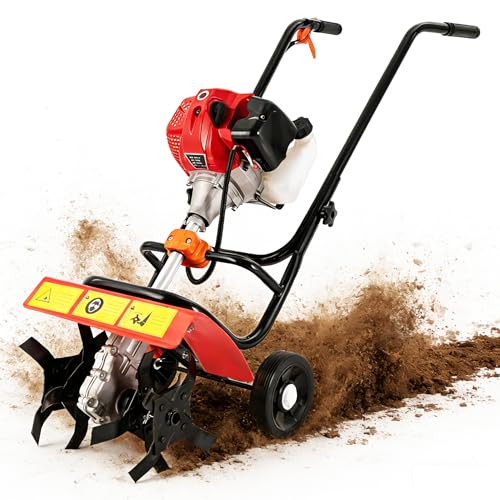
Best for: flower beds and narrow raised beds under 14 in wide Skip it if: you need to break new ground deeper than 4 in
The EEYBLAEEY is a walk behind garden tiller for people whose garden is a set of beds, not a field. EEYBLAEEY says the engine is a 52cc 2-cycle, that the working width is approximately 14 in and the adjustable depth reaches 4 in, and that four heat-treated steel tines do the cutting. Its 31.5 x 14.6 x 14.6 in frame is genuinely narrow, so it moves between rows and between raised beds in a way the Baotree cannot. As the cheapest of the five, it lowers the entry price for a walk behind meaningfully.
The compromises are visible in the same spec sheet. A 2-cycle engine wants a fuel-and-oil mix, which is more maintenance than the Sun Joe's plug and the Baotree's 4-stroke. Depth tops out at 4 in per the listing, so this is a cultivator for mixing amendments and light weeding rather than a first-pass tiller for compacted clay. Working weight is not published, and only one seller lists the model, which narrows your options if you want to compare on other terms.
Pros:
- Cheapest pick in this set
- Narrow 14.6 in frame moves between raised beds
- 52cc 2-cycle engine, per the listing
- Four heat-treated steel tines
- Sized for flower beds and vegetable patches
Cons:
- Depth capped at 4 in per the listing
- 2-cycle engine needs a fuel-oil mix
- Working weight is not published
- Only one seller lists this model
4. Echo TC-210 9 in. 21.2 cc Gas Tiller/Cultivator — Best premium
The narrowest published cut in the set, at 9 in, on the premium end of the price ladder.

Best for: tight rows and cultivating between established plants Skip it if: you want a wide first-pass tiller for open ground
The Echo TC-210 is a specialist. The listing publishes a 9 in cutting width, a 21.2 cc engine, a 27 lb weight and front-tine forward-rotating action. That is a tool built for cultivating rather than breaking sod. Between rows of tomatoes or between shrubs where a 20 in Baotree would tear roots, a 9 in front-tine at 27 lb goes places a wide machine cannot. It is the second-lightest here by a fraction, one seller lists it, and it sits at the top of the price ladder in this set.
The listing is thin on other detail. Depth is not published, so if that number matters to you, you are shopping partly blind, and the model identifier on the record is a placeholder rather than a real product code. The feature bullet on Amazon reads only "Great tools at a great price", which is not useful evidence. What you are paying for is the Echo name and a narrow, purpose-built shape. If you already run Echo 2-cycle equipment, familiar fuel mix and starting behaviour is a genuine convenience.
Pros:
- Narrowest published cut at 9 in for tight cultivation
- Published weight of 27 lb
- Front-tine forward-rotating design
- Compact 13.1 x 27.8 x 13.1 in footprint
Cons:
- Depth figure is not published
- The most expensive position in this set
- Only one seller lists the model
- Feature detail on the listing is minimal
5. OMMUNICT 63CC Walk Behind Brush Cutter — Best minimal setup
The largest engine displacement in the set at 63cc, in a walk behind body pitched at more than tilling alone.

Best for: mixed jobs where tilling is only part of the work Skip it if: deep-till performance in heavy soil is your priority
The OMMUNICT is the odd shape here, and that is the point. The listing calls it a 3-in-1 walk behind cultivator, brush cutter and trimmer with a 63cc 4-stroke engine rated at 4 hp, a 240 rpm rotational speed, a 30.5 lb body and a 17.3 x 57.1 x 27.6 in frame. If your yard needs weeding, plowing, tilling and furrowing done by one machine rather than four, this pick trades depth of specialisation for breadth. Sits at a mid position on the price ladder for the set.
Weigh the trade honestly. Neither working width nor working depth is published, so the two figures that decide a tilling job are missing from the sheet. The 240 rpm figure is slow, which suits a brush cutter but tells you little about how the same drivetrain performs pushing tines through packed soil. The listing sits under walk-behind lawn mowers, not tillers, so the machine is a cultivator that also mows rather than a tiller that also trims. Buy this one for versatility, not for a first-pass on hard ground.
Pros:
- Largest engine displacement in this set at 63cc
- 4-stroke design uses straight gasoline
- 3-in-1 use case per the listing
- Pull-start with upright operating position
Cons:
- Working width is not published
- Working depth is not published
- 240 rpm is slow for aggressive tilling
- Heaviest published weight at 30.5 lb
Width and depth: the specification that actually decides it
Most walk behind garden tiller guides compare engine size. That is not what decides it. Working width and working depth are, because those are the numbers that translate into how many passes you make and whether the machine reaches root zone.
The Baotree publishes a 20 in width and a 10 in depth. The Sun Joe publishes 16 in and 8 in. The EEYBLAEEY publishes about 14 in and 4 in. The Echo publishes 9 in and does not publish a depth. The OMMUNICT publishes neither.
Read that spread and a rough cutoff appears:
- If you are turning over an unbroken plot, you want 16 in or wider and 8 in or deeper.
- If you are refreshing beds you already worked last year, 14 in and 4 in is enough.
- If you are cultivating between plants, a 9 in front-tine wins on access, not on volume.
Width without depth is a lie the market tells you. A wide tine that only cuts 3 in deep leaves the compacted layer intact, and by August the plants know. Depth without width means an honest bed still takes six passes to cover.
Gas or corded electric for a home garden?
This is the question every buyer eventually asks, and the answer is not universal. Four of the five picks here are gas, and one is corded electric.
Gas gets you range. The Baotree, EEYBLAEEY, Echo and OMMUNICT all run on their own tanks, so the only limit is how much you feel like refuelling. Gas engines also tend to swing harder into hard soil, which is why every listing that publishes a depth deeper than 4 in in this set is gas.
Corded electric gets you simplicity. The Sun Joe TJ604E starts on a trigger, needs no oil, no fuel mix, no spark plug attention, and stores on a folding handle. Its published 8 in depth and 16 in width beat two of the three gas picks in this set on the numbers that matter, which is the point of naming it Best upgrade rather than a compromise.
The deciding factor is distance from a socket. If your outdoor outlet reaches your plot with one heavy-gauge extension, corded electric is the lower-hassle choice. If it does not, the Baotree is the machine you want.
What the product listings do not tell you
The Amazon listings for these five machines each leave gaps that matter. Read them like a shopper, not like a manufacturer, and this is what you are actually missing:
- Weight, sometimes. Baotree does not publish a working weight. Sun Joe, Echo and OMMUNICT do. EEYBLAEEY does not. Weight matters for hauling the machine into a shed and for wrestling it in a turn.
- Depth, sometimes. Echo and OMMUNICT do not publish a working depth. Depth is half the answer to whether the tool suits your soil.
- Warranty. None of the five listings, as supplied, publishes a warranty period. If that matters, verify on the manufacturer's own site before buying.
- Fuel type detail. The Baotree and OMMUNICT are 4-stroke, so they run on straight gasoline. The EEYBLAEEY is 2-cycle, which means a fuel-oil mix and a habit of not letting the mix sit in the tank for months.
- Tine count and configuration. Sun Joe lists six steel tines. EEYBLAEEY lists four heat-treated tines. Baotree, Echo and OMMUNICT do not put a count in the listing.
None of this is a reason not to buy, but every gap is a question you should be ready to ask before you commit.
Which tiller fits your plot?
A short if/then map, using only what the listings tell us:
- If your plot is 500 square feet or larger of unbroken or compacted ground, buy the Baotree for its 20 in width and 10 in depth claim.
- If your plot is smaller, already worked, and inside extension-cord range of an outlet, buy the Sun Joe TJ604E.
- If you only work raised beds and narrow flower borders, buy the EEYBLAEEY for its 14.6 in frame.
- If your work is cultivating between established rows and shrubs, buy the Echo TC-210 for its 9 in width.
- If tilling is only one of four yard jobs you want a single machine to handle, buy the OMMUNICT.
The verdict
If you want one walk behind garden tiller and only one, buy the Baotree 4 Stroke Gas Tiller Cultivator. It publishes the widest cut here at 20 in, the deepest at 10 in, and pairs them with a six-position handle and a 4-stroke engine that uses regular gasoline. For a mid-sized vegetable plot on real soil, that combination decides the job in fewer passes than anything else in this set.
The two-track answer looks like this. If your plot is smaller, already broken and within reach of an outdoor outlet, buy the Sun Joe TJ604E instead: 16 in wide, 8 in deep per the listing, a 13.5-amp motor, a folding handle and 27.1 lb on the scale. The cutoff is roughly 500 square feet of compacted ground: below it, the Sun Joe is easier to live with; above it, the Baotree earns its price position with width and depth. If neither describes your work, the map in the previous section names the pick.
At the premium end, the Echo TC-210 is a purpose-built 9 in cultivator, not a wider machine's equal. At the entry end, the EEYBLAEEY covers narrow beds honestly, and the OMMUNICT covers mixed yard work if you accept the missing depth figure.
FAQ
What size walk behind garden tiller do I need?
What size walk behind garden tiller you need comes down to the width and depth of the ground you cover. For unbroken or compacted plots, aim for at least 16 in wide and 8 in deep, which the Baotree and Sun Joe both publish. For raised beds and borders under 14 in wide, the EEYBLAEEY's 14.6 in frame fits where wider machines cannot turn.
Is a corded electric walk behind garden tiller worth it?
Is a corded electric option worth it? Yes, when your plot sits inside cord range of an outdoor outlet. The Sun Joe TJ604E publishes a 16 in width and 8 in depth on a 13.5-amp motor with a folding handle and 27.1 lb weight. You skip fuel, oil and pull starts entirely. The catch is range: past a long extension, a gas pick like the Baotree wins.
How deep should a garden tiller cut for a vegetable bed?
How deep should a garden tiller cut? For a working vegetable bed, look for 8 in or more, which reaches typical root zone for most crops. The Baotree claims 10 in and the Sun Joe claims 8 in. The EEYBLAEEY tops out at 4 in per the listing, which is fine for mixing amendments but shallow for turning over a new bed.
Baotree 4 Stroke vs Sun Joe TJ604E, which wins?
Baotree 4 Stroke vs Sun Joe TJ604E depends on power source and plot size. The Baotree publishes a wider 20 in cut, a deeper 10 in reach and a 1.5 kW engine, and it needs no cord. The Sun Joe publishes 16 in and 8 in, weighs 27.1 lb, folds for storage and plugs into any outdoor outlet. Big plot, buy the Baotree. Small plot near an outlet, buy the Sun Joe.
What is the biggest mistake buying a walk behind garden tiller?
The biggest mistake buying a walk behind garden tiller is chasing engine size while ignoring width and depth. A 63cc listing with no published working width tells you nothing about how many passes your plot needs. Confirm the two numbers that decide the job, verify weight if you have to lift the machine into a shed, and treat manufacturer feature bullets as claims rather than measurements.
If you have read this far, the shortlist is short. Order the Baotree if your plot is unbroken or compacted and you want one machine to carry the whole season, because 20 in of published width and 10 in of depth turn a two-day job into an afternoon. Order the Sun Joe TJ604E if you have an outdoor outlet, a smaller plot and a preference for tools that start on a trigger. The other three picks each answer a narrower question well: raised beds, tight rows, or a yard that needs more than tilling. Match the pick to your soil and your socket, and the machine will still be earning its keep three springs from now.