Best Tow Behind Lawn Aerator for Compacted Soil

Five tow-behind aerators compared on tine design, working width and weight tray capacity, with a clear winner for compacted soil and a runner-up for two-pass lawn care.

By Dane JonesUpdated 14 min read
On this page
- Best tow behind lawn aerator at a glance
- What most buyers get wrong about spike aerators
- 1. BlumeTrec 40-Inch Tow Behind Spike Aerator — Best overall
- 2. VEVOR Tow Behind Plug Aerator — Best budget pick
- 3. JFHID 40'' Tow Behind Lawn Plug Aerator — Best for beginners
- 4. Brinly SAT2-40BH-P Tow Behind Spike Aerator — Best for heavy use
- 5. Brinly Combination Aerator Spreader — Best premium
- How to read a weight tray spec
- Spike vs plug: which does this set actually give you?
- What size tow-behind fits your tractor?
- Setup and storage: what owning one really involves
- The verdict
- FAQ
The best tow behind lawn aerator for compacted soil is the BlumeTrec 40-Inch Tow Behind Spike Aerator, a 42.5 lb steel unit with 10 galvanized 3D tine stars and a weight tray rated for 110 lb of added ballast. If you want a wider single-pass tool with a stated 200 lb weight capacity, the JFHID 40-inch is the better buy. Everything below is drawn from listing specifications and manufacturer claims for these five picks.
Best tow behind lawn aerator at a glance
| Pick | Working width | Weight tray | Price |
|---|---|---|---|
Best overall BlumeTrec 40-Inch Tow Behind Spike Aerator |
40 in | 110 lb claim | Check Price |
Best budget pick VEVOR Tow Behind Plug Aerator |
32 in | 100 lb claim | Check Price |
Best for beginners JFHID 40'' Tow Behind Lawn Plug Aerator |
40 in | 200 lb claim | Check Price |
Best for heavy use Brinly SAT2-40BH-P Spike Aerator |
40 in (11 tine stars) | 150 lb claim | Check Price |
Best premium Brinly Combination Aerator Spreader |
40 in with hopper | 75 lb claim | Check Price |


What most buyers get wrong about spike aerators
Most buyers compare tow-behind aerators by working width alone. Width sells the tool but does not fix compacted soil. What actually decides the job is the downward force pressing each tine into the ground, and that force comes from the tray weight you add, not from the empty machine.
Four of these five picks state their tray capacity in the listing. The JFHID claims the highest at 200 lb, Brinly's spike aerator sits at 150 lb, BlumeTrec at 110 lb, VEVOR at 100 lb, and the Brinly combination unit at 75 lb because part of its tray load is the seed hopper. That spread is the real story of this category. A 40-inch bar of tines with an empty tray will skate over dry clay. The same bar with 150 lb of sandbags on the tray will punch tines to their full stated depth.
Read the tray number first, working width second. Then check that your tractor can actually pull that loaded weight without the rear wheels lifting under acceleration.
1. BlumeTrec 40-Inch Tow Behind Spike Aerator — Best overall
The BlumeTrec wins on the balance of tine design, weight tray, and the transport lever, at a mid price for the set.
Best for: half-acre lawns with compacted clay and a mid-size lawn tractor Skip it if: you need true core plugs pulled from the soil
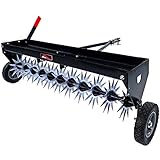
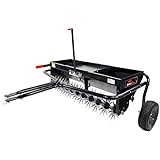
The BlumeTrec is the only pick in this set that publishes a full triple of size, weight and dimensions: 40 in working width, 42.5 lb bare, 19 x 40 x 30.3 in overall. Ten galvanized 3D tine stars sit on a solid steel axle, and BlumeTrec says each tine carries 11 irregular tips that rotate independently and reach up to 2 in into the soil. The weight tray takes up to 110 lb of ballast per BlumeTrec's spec, which sits between VEVOR's 100 lb claim and Brinly's 150 lb figure. A single side lever swaps between working mode and wheeled transport mode, so you cross driveways without walking around to lift the bar. Price position is the middle of the five here, and it is the one buyers choose most often in this set. The trade-off is honest: this is a spike aerator, not a plug aerator, so it perforates rather than removes cores. If your soil is severely compacted clay that needs core extraction, a hollow-tine machine does more.
Pros:
- 10 galvanized 3D tine stars with 11 tips each per BlumeTrec
- Full published size, weight and dimensions
- Side lever for transport mode with wheels
- 110 lb tray capacity claim for deeper penetration
- Mid price position in this set
Cons:
- Spike design, not core plug extraction
- No published warranty
- Lower tray capacity than the JFHID and Brinly SAT2
2. VEVOR Tow Behind Plug Aerator — Best budget pick
The VEVOR is the cheapest of the five and the lightest at 27.6 lb, at the cost of an 8-inch narrower pass.

Best for: smaller yards where cost matters more than a wider pass Skip it if: you have a large lawn and want to finish in one pass
The VEVOR runs a 32 in working width, the narrowest here, and weighs 27.6 lb bare on 11.8 x 32.7 x 32.3 in overall dimensions. That 8 in gap against the four 40-inch picks translates into more passes to cover the same area. On a small lot the extra passes cost little time. On a large lot they add up quickly. VEVOR says the tines reach up to 2 in deep and the tray takes up to 100 lb of extra weight, and calls out folded edges on the front and back of the tray to hold cinder blocks or sandbags in place. The frame is fully welded steel per VEVOR's listing. It is the cheapest of the five and it is second-slowest seller in this set. The trade-off is straightforward: you give up 8 in of working width and 10 lb of tray capacity to hit the lowest price here. That is a fair swap on a quarter-acre lawn. It is a poor swap on anything larger.
Pros:
- Cheapest of the five picks
- Lightest bare weight at 27.6 lb
- Folded tray edges to hold cinder blocks per VEVOR
- Fully welded steel frame claim
- Universal hitch design
Cons:
- Narrowest working width at 32 in
- Lowest published tray capacity at 100 lb
- No transport-mode lever mentioned
- No published warranty
3. JFHID 40'' Tow Behind Lawn Plug Aerator — Best for beginners
The JFHID pairs the widest published tray capacity in the set with a 40 in pass, at the second-cheapest price here.

Best for: first-time buyers who want the widest pass and simple setup Skip it if: you need a published warranty on the frame
The JFHID is a 40 in tow-behind on 8 in tires, with 33.9 x 48.4 x 11.3 in overall dimensions. JFHID says the tray takes up to 200 lb of added weight, the highest number in this set by a clear margin. That figure matters if your soil is dense: more ballast means more downward force per tine tip, and more force means the tines actually reach depth instead of skipping. JFHID also lists adjustable height with a secure lock, which lets you match tine pressure to soft or hard ground rather than committing to one setting. The universal hitch fits most riding mowers, lawn tractors, ATVs and UTVs per the listing. Price position is the second-cheapest here. Two trade-offs to note. The listing publishes no bare weight, which makes it harder to judge trailer or storage load against the BlumeTrec's 42.5 lb figure. And there is no published warranty, unlike the two Brinly picks that both state two years.
Pros:
- Highest published tray capacity in the set at 200 lb
- 40 in working width matches the widest here
- Adjustable height with a secure lock per JFHID
- Second-cheapest price position
- 8 in tires for smoother rolling
Cons:
- No published bare weight in the listing
- No stated warranty
- Slowest seller in this set
4. Brinly SAT2-40BH-P Tow Behind Spike Aerator — Best for heavy use
The Brinly SAT2 is the only single-purpose spike aerator here with a published two-year warranty, at the second-highest price position.
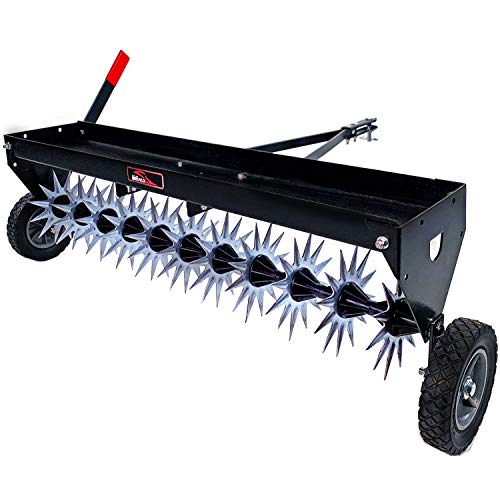
Best for: repeat seasonal use on tough soil where a warranty matters Skip it if: you also want to spread seed or fertilizer in the same pass
The Brinly SAT2 lists 11 tine stars at 8 in diameter, each carrying 12 spike tips, penetrating up to 2 in per Brinly. That tine count is one higher than the BlumeTrec's ten. Overall dimensions run 24.3 x 26 x 46.5 in, taller than the BlumeTrec because of the double tow bar Brinly names as extra-strength. The tray holds up to 150 lb of added weight per Brinly, sitting between BlumeTrec's 110 lb and JFHID's 200 lb. A single lever engages turf-tread transport wheels to cross driveways and sidewalks. The two-year warranty is the specification that separates this pick from the BlumeTrec, the VEVOR and the JFHID, none of which publish warranty terms. Two honest trade-offs. Price position is the second-highest of the five, and Brinly's patent-pending 3D tine claim, while attributed, is a marketing line about strength rather than a measured figure you can compare to another brand's tines.
Pros:
- Two-year warranty in the listing
- 11 tine stars with 12 tips each per Brinly
- 150 lb tray capacity claim
- Single-lever transport wheels
- 5/8 in solid steel axle per the listing
Cons:
- Second-highest price position in the set
- No published bare weight
- Single-purpose: no spreader
5. Brinly Combination Aerator Spreader — Best premium
The Brinly combination is the only pick in this set that aerates and spreads seed, fertilizer or lime in one pass.
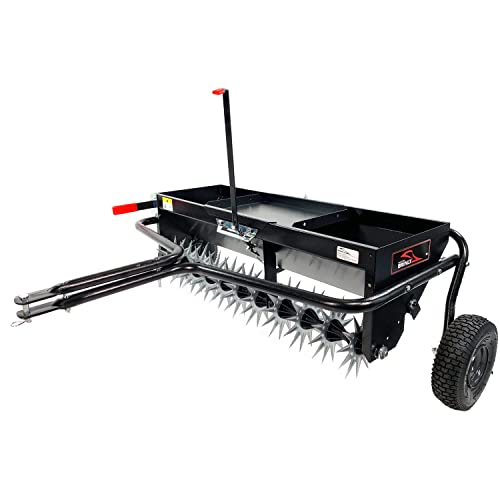
Best for: overseeding jobs where aerating and spreading happen together Skip it if: you already own a broadcast spreader
This is the most expensive pick here and the one that stops being a pure aerator. Brinly says it drops seed, fertilizer or lime while you aerate, so freshly perforated holes catch the material as it lands. The steel hopper holds 100 lb, listed at 1.74 cu ft, and the tine stars are 8 in diameter with a stated 132 tine tips reaching up to 2 in deep. Overall dimensions are 18 x 37.5 x 55 in, and the tow bar sits at 40 in working width. Warranty is two years per the listing. The catch is the tray. Because part of the ballast space carries the hopper, the added-weight tray only takes up to 75 lb per Brinly, the lowest figure in this set. So you gain a spreader and lose ballast capacity, which means less downward force per tine. On lightly compacted lawns that trade is fine. On heavy clay you would want the SAT2 and a separate spreader. It is the second-slowest seller in the set, which is what you would expect from the most expensive and most specialised pick here.
Pros:
- Aerates and spreads in one pass
- 100 lb steel hopper at 1.74 cu ft per Brinly
- 132 tine tips at 2 in depth claim
- Two-year warranty
- 40 in working width
Cons:
- Highest price position in the set
- Lowest tray capacity here at 75 lb
- More parts to clean and store than a plain aerator
How to read a weight tray spec
Tray capacity is quoted three ways across these listings, and confusing them will cost you results. Read the number this way.
- The tray figure is the maximum added weight the frame is rated to carry, not the tine pressure. BlumeTrec says up to 110 lb, VEVOR 100 lb, JFHID 200 lb, Brinly SAT2 150 lb, Brinly combination 75 lb.
- The pressure that reaches the soil is the added weight plus the machine's own weight, spread across all tine tips in contact with the ground at once.
- More tips means less force per tip. The Brinly SAT2 lists 11 stars with 12 tips per star. The Brinly combination lists 132 tips total. Tight tip spacing improves coverage. It also spreads your ballast thinner.
- If your soil is dry and hard, ballast the tray to near the stated maximum before your first pass, and reduce for the second.
The upshot: pick the widest tray capacity you can actually load, and match tine density to how thin you are willing to spread that ballast.
Spike vs plug: which does this set actually give you?
The keyword covers both. This set is mostly spike aerators. Read the model pages carefully before you order.
The BlumeTrec, the Brinly SAT2 and the Brinly combination are described as spike aerators in their titles or feature bullets. Spike aerators perforate the soil by pressing tine points down and pulling them straight back up. The VEVOR and JFHID titles say plug aerator, though both listings mention high-strength tines rather than the hollow coring tines a true plug aerator uses to pull cylindrical cores out of the ground. That mixed language is common in this category and it is why the listings need reading twice.
If your goal is to break up a thatched, heavily compacted lawn, a genuine core aerator with hollow tines does the job that no spike unit fully replaces. If your goal is annual maintenance on a lawn that already drains, a spike aerator is faster, lighter and easier to store. Four of these five are the second job. Decide which job you have before you decide which pick.
What size tow-behind fits your tractor?
Working width sets pass count, but the pull test is the loaded weight the tractor moves without lifting a rear wheel or stalling on a rise.
- Sub-compact riding mower, tight turns: the VEVOR at 32 in and 27.6 lb bare is the easiest to handle. Load the tray light.
- Mid-size lawn tractor, half-acre-plus lot: the BlumeTrec at 40 in and 42.5 lb bare is the most balanced choice, with 110 lb of tray capacity to work with.
- Full-size lawn or garden tractor, heavy clay: the JFHID's 200 lb tray claim and the Brinly SAT2's 150 lb tray and heavier build put more force per tine tip on stubborn ground.
- Utility tractor or ATV with a spreader on your list: the Brinly combination consolidates two jobs into one pass at the cost of tray capacity.
Also check the hitch. All five list a universal hitch, but universal covers a range of pin sizes, so measure your drawbar before you commit.
Setup and storage: what owning one really involves
None of these five arrive assembled. BlumeTrec's listing calls out an illustrated instruction manual for the assembly step, which tells you assembly is a real job rather than a five-minute unbox. Budget an hour on a workbench with basic hand tools.
Storage matters more than most first-time buyers expect. The BlumeTrec measures 19 x 40 x 30.3 in, the VEVOR 11.8 x 32.7 x 32.3 in, the JFHID 33.9 x 48.4 x 11.3 in, the Brinly SAT2 24.3 x 26 x 46.5 in, and the Brinly combination 18 x 37.5 x 55 in. Not one of them stands neatly against a garage wall. Two of the four spike-only picks have a transport-mode lever that lifts the tines onto wheels, which is also how you park it inside. If you plan to leave the tool outdoors, the galvanized tine claim on the BlumeTrec and the two Brinly picks matters, and a tarp still helps. After use, sandbag off, tines wire-brushed, and axle wiped down. Ten minutes now saves a rusted bearing later.
The verdict
For a compacted half-acre or so, the best tow behind lawn aerator is the BlumeTrec 40-Inch Tow Behind Spike Aerator. It is the pick with the fullest published spec sheet in this set, ten galvanized 3D tine stars, a 110 lb tray capacity, a proper transport-mode lever, and a mid price that undercuts both Brinly units. It is also the one buyers choose most often in this set.
Two conditions flip the recommendation. If your soil is dense enough that you want to load the tray beyond 110 lb, step to the JFHID and its 200 lb tray claim for the same 40 in working width. If you plan to overseed the same afternoon you aerate, the Brinly combination consolidates aeration and spreading into one pass, and you accept a 75 lb tray in exchange. If you use the aerator every spring and every fall on tough ground and want a published warranty behind that use, the Brinly SAT2 is worth its higher price position for the two years of coverage the BlumeTrec, VEVOR and JFHID all lack. The VEVOR remains the right pick if your lot is small and the cheapest ticket in matters more than a wider single pass.
FAQ
Is a tow behind lawn aerator worth it over a manual one?
A tow behind lawn aerator is worth it once your lawn is large enough that a manual tool becomes a weekend job. The five picks here cover 32 to 40 in per pass. A manual aerator covers a few inches. On a half-acre lawn, the tow-behind finishes in an afternoon behind the tractor you already own, and it does not leave your back sore the next morning.
What is the best tow behind lawn aerator for compacted clay?
The best tow behind lawn aerator for compacted clay in this set is the BlumeTrec, because it pairs 10 galvanized 3D tine stars with a 110 lb weight tray and a single-lever transport mode at a mid price. If you have clay that resists that ballast, the JFHID's 200 lb tray claim and the Brinly SAT2's 150 lb tray with 11 tine stars give you more downward force per pass.
BlumeTrec versus Brinly SAT2, which one should I buy?
BlumeTrec versus Brinly SAT2 comes down to warranty and price. The BlumeTrec sits at a mid price position and publishes no warranty. The Brinly SAT2 sits at the second-highest price position in this set and lists a two-year warranty, 11 tine stars and a 150 lb tray. If you aerate once a year, the BlumeTrec wins on value. If you aerate every spring and fall, the Brinly's warranty earns the premium.
What weight should I load in the tray of a tow behind aerator?
The weight you load in the tray depends on soil hardness and the machine's rated capacity. Start at roughly half the stated maximum, so around 50 lb on the VEVOR or BlumeTrec, and pass once. If the tines skate rather than sink, add ballast in 25 lb steps up to the listed limit: 100 lb on the VEVOR, 110 lb on the BlumeTrec, 150 lb on the Brinly SAT2, 200 lb on the JFHID.
Do tow behind aerators pull cores like a real plug aerator?
Tow behind aerators in this set mostly do not pull cores like a hollow-tine plug aerator. The BlumeTrec, the two Brinlys and, in practice, the VEVOR and JFHID use spike-style tines that perforate the soil rather than remove cylindrical plugs. For annual maintenance on a lawn that already drains, that is enough. For a thatched, severely compacted lawn, a rented core aerator with hollow tines does the deeper job first.
Aerating in the right week matters as much as the tool you pull behind you. Aim for the window when the soil is moist enough for the tines to sink but firm enough not to smear, which is usually early fall in cool-season lawns and late spring in warm-season ones. Order the BlumeTrec now, spend an hour on assembly, load the tray, and you will have a repeatable half-day job on a large lawn that used to take a weekend of manual work. Match the machine to your soil, your tractor and your storage, and the same tool will still be earning its space in the shed a decade from now.