Best Ratchet Loppers for Raised Beds: Spear & Jackson Wins

A ranked shortlist of six ratchet loppers with the specifications that actually matter for raised-bed work: weight, reach, blade steel and warranty.

By Dane JonesUpdated 17 min read
On this page
- How I screened the field down to six
- Best ratchet loppers for raised beds at a glance
- Why weight matters more than cutting capacity
- 1. Spear & Jackson 8290RS Razorsharp Heavy Duty Telescopic — Best overall
- 2. Kimura Pro Heavy Duty Garden Loppers — Best for families
- 3. EZ Kut BranchCutter Anvil Loppers — Best lightweight
- 4. Jardineer Ratchet Anvil Loppers — Best budget pick
- 5. Spear & Jackson Kew Gardens Razorsharp — Best premium
- 6. ALLWAY GA-XRTL Extendable Jumbo Ratchet — Most versatile
- How much reach do raised beds actually need?
- What the raised-bed angle means for pick order
- Which blade steel and coating should you pick?
- How the two Spear & Jackson models compare
- The verdict
- FAQ
The best ratchet loppers for raised beds are the Spear & Jackson 8290RS Razorsharp, which pair a 4.17 lb body with handles that telescope out to 40 1/2 in, so you can lean over a filled bed without stepping on the soil. If wrist fatigue is your real problem, the EZ Kut BranchCutter is the better buy at 1.75 lb and 18 in long, though you give up the reach.
How I screened the field down to six
I started with roughly forty ratchet-lopper listings in the Hand Tools > Loppers category and cut them on published data, not marketing copy.
Three filters did most of the work:
- Ratchet mechanism confirmed in the specifications or feature bullets. Anything sold as "heavy duty" without a named ratchet was out.
- A stated weight or overall length. If the listing does not publish either figure, a raised-bed buyer cannot judge whether the tool clears the frame.
- A blade steel or coating claim from the manufacturer. SK5 carbon steel with a PTFE or Teflon coating is the pattern in this segment, and picks that named neither were dropped.
That left the six in the table. Two are Spear & Jackson, which is why one of the sections below compares them directly. Three are telescopic and three are fixed-length, which gives you a real choice rather than six near-copies. The order below reflects how well each one suits pruning around a raised bed specifically, not general lopping.
A note on the search term itself: Amazon's results for "ratchet loppers for raised beds" mostly return general-purpose ratchet loppers, because no manufacturer in this set markets a lopper as raised-bed-specific. So the qualifier is a use case you apply, not a feature the box promises. That shapes the whole ranking.
Best ratchet loppers for raised beds at a glance
| Pick | Reach | Weight | Price |
|---|---|---|---|
Best overall Spear & Jackson 8290RS Razorsharp |
Extends to 40 1/2 in | 4.17 lb | Check Price |
Best for families Kimura Pro Heavy Duty Garden Loppers |
25 to 37 in | 2.76 lb | Check Price |
Best lightweight EZ Kut BranchCutter Anvil Loppers |
Fixed 18 in | 1.75 lb | Check Price |
Best budget pick Jardineer Ratchet Anvil Loppers |
Fixed 30.5 in | 4.99 lb | Check Price |
Best premium Spear & Jackson Kew Gardens Razorsharp |
Extends to 40 in | Not listed | Check Price |
Most versatile ALLWAY GA-XRTL Jumbo Ratchet |
28 to 41 in | 4.28 lb | Check Price |


Why weight matters more than cutting capacity
Most guides for the best ratchet loppers for raised beds compare cutting capacity first. That is the wrong lead. Every pick in this set claims 2 in or thereabouts, which is more than a raised bed needs. Blueberry canes, tomato stakes, spent brassica stems, small fruit tree suckers: nothing in a bed comes close to 2 in on a regular Saturday.
Weight and reach are what actually decide it, because a raised bed changes your posture. You lean forward across the frame instead of walking into the plant, and you often hold the tool at arm's length rather than close to the chest. A 4.99 lb lopper held straight out at 30 in works your shoulders more than the same tool held close on lawn work.
That reshapes the ranking. The 1.75 lb EZ Kut is the lightest in this set, and the 2.76 lb Kimura is the lightest of the telescopic options. The 4.99 lb Jardineer is the heaviest by more than half a pound. Cutting capacity is a floor, not a differentiator here, and the floor is already low enough.
1. Spear & Jackson 8290RS Razorsharp Heavy Duty Telescopic — Best overall
A moderate weight, real telescoping reach and a published ten-year guarantee make this the ratchet lopper to default to for raised-bed work.
Best for: raised-bed gardeners who need reach without the weight of a full-size pair Skip it if: you want the shortest, lightest packable option
At 4.17 lb, the 8290RS sits in the middle of this set for weight, but it is the only pick that pairs a moderate weight with handles that extend to 40 1/2 in. That combination is what raised beds ask for. You can stand at the outside edge of a four-foot bed and still cut a cane on the far side without kneeling on the soil or twisting your spine. Spear & Jackson says the upper blade is SK5 carbon steel with a PTFE coating for rust resistance, and the tubular aluminium handles carry soft, non-slip grips.
The other reason it wins: it is the only pick in this set with a published warranty, a ten-year guarantee against manufacturing faults and defects. Everything else here ships with silence on that front. For a tool you leave in a damp shed and haul out ten times a season, that guarantee is a real piece of value.
The trade-off is bulk. A packable 18 in tool this is not, and if your beds are all within one comfortable step, the 8290RS is more lopper than you need.
Pros:
- Telescopes to 40 1/2 in for reach across a filled bed
- 4.17 lb, lighter than the two heaviest picks in this set
- 10-year manufacturer guarantee, the only one here
- SK5 carbon steel upper blade with PTFE coating claimed
- Soft, non-slip grips on tubular aluminium handles
Cons:
- Not the lightest option if wrist fatigue is your main problem
- Bulkier to store than a fixed 18 in tool
- Multicoloured finish is loud in a garden photo
2. Kimura Pro Heavy Duty Garden Loppers — Best for families
The lightest telescopic option in this set, with a 25 to 37 in range that suits a shared shed where kids and adults both reach for the same tool.

Best for: a shared garden shed where the tool passes between hands and heights Skip it if: you want a published warranty in writing
The Kimura weighs 2.76 lb, which makes it the lightest telescopic pick here by a clear pound and a half over the ALLWAY and the Spear & Jackson 8290RS. That matters when a lopper is shared. A tall adult can extend to 37 in for a fruit tree sucker, and a teenager or smaller adult can collapse it back to 25 in for waist-high work on a raised bed without wrestling the tool. Kimura says the blades are Japanese SK5 steel with a PTFE coating, and the handles are aluminium with soft TPR grips.
The listing describes the ratchet as multiplying cutting power up to five times, which is the boldest claim in this set. It is the manufacturer's figure, not a measured one, so treat it as a design intent rather than a promise. In the same set, ALLWAY claims 1.6x and 40% less effort, which is quieter marketing for the same underlying mechanism.
Where it loses ground on the 8290RS is documentation. No warranty is published for the Kimura in the listing data, and it is the second-cheapest pick here, so you are paying for the weight advantage rather than the paperwork.
Pros:
- 2.76 lb, the lightest telescopic pick in this set
- 25 to 37 in twist-lock adjustment covers most bed heights
- Japanese SK5 steel anvil blade with PTFE coating claimed
- Soft TPR grips on aluminium handles
- Second-cheapest pick here
Cons:
- No warranty published in the listing
- The 5x cutting-power figure is a manufacturer claim, not a measurement
- Only one seller lists it
3. EZ Kut BranchCutter Anvil Loppers — Best lightweight
A fixed 18 in tool at 1.75 lb, built for close work at the bed rather than reach across it.

Best for: wrist-friendly work close to the bed with no ladder involved Skip it if: you need to reach a branch two feet above your head
The BranchCutter is the outlier in this set and the case for it is simple: 1.75 lb, half the weight of the Kimura and roughly a third of the Jardineer. EZ Kut describes it as a sub-compact packable lopper, 18 in long, with a hardened SK5 blade and a non-stick coating. The mechanism offers a ratchet cut for tough wood and a single-squeeze cut for quick work, so you are not forced through four clicks on a soft cane.
For raised beds specifically, the trade-off is honest. You lose reach entirely. If your beds are narrow enough to reach across from the outside edge, and if you are cutting canes, herbs and pepper stems rather than branches over your head, the weight saving is the biggest ergonomic gain any pick in this set offers. Wrists and elbows notice a two-pound difference more than a two-inch cutting-capacity difference.
It is the second-most expensive pick here and it sells more slowly than the Spear & Jackson or the Kimura, so you are paying a premium for the compact format. EZ Kut has been making yard tools since 1988, per the listing, but no warranty figure is published.
Pros:
- 1.75 lb, the lightest pick in this set
- Fixed 18 in length stores in a bucket or a pack
- Dual mode: ratchet cut and single-squeeze cut
- SK5 hardened steel blade with non-stick coating claimed
- Cuts up to 2 in branches per the listing
Cons:
- No telescoping reach at all
- Premium price for a compact tool
- No published warranty
- Slowest seller of the top three picks here
4. Jardineer Ratchet Anvil Loppers — Best budget pick
The cheapest of the six, with a fixed 30.5 in handle and an SK5 spare blade in the box.
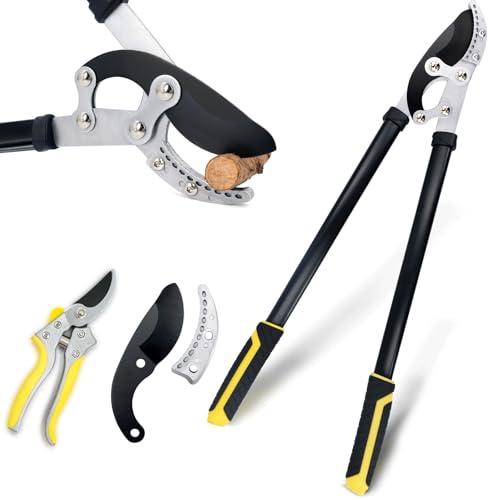
Best for: occasional cleanup of dry, dead wood at ground level Skip it if: you lift the tool overhead often
Jardineer takes the entry-price slot here and the listing throws in extras to make the point: a spare SK5 blade and a compact bypass hand pruner ship with the lopper. For a gardener building out a raised-bed toolkit from nothing, that is a reasonable single purchase.
The specifications are where it earns the fourth spot rather than a higher one. At 4.99 lb it is the heaviest in this set, and the handle is a fixed 30.5 in of thickened steel rather than aluminium. Steel handles are why the weight is where it is. The anvil design is called out for dry, dead and thick hardwood, which matches how you actually use a lopper at ground level: clearing brassica stems, old raspberry canes, dry fruit-tree suckers after winter.
Held at arm's length across a raised bed, though, that 4.99 lb becomes a workout. It is a fine tool for standing next to a bed and reaching down into it, and a less comfortable tool for leaning over the frame. The steel handle is also less forgiving than aluminium if you leave it out in the wet.
Pros:
- The cheapest pick in this set
- Spare SK5 blade included
- Bypass hand pruner included
- 2 in cutting capacity claimed
- Anti-rust Teflon coating claimed
Cons:
- 4.99 lb, the heaviest pick here
- Fixed length, no telescoping reach
- Steel handles rather than aluminium
- No warranty published in the listing
5. Spear & Jackson Kew Gardens Razorsharp — Best premium
The Kew Gardens badge, a twist-and-lock telescope out to 40 in and a locking catch for safer storage, at the top price position in this set.

Best for: a gardener who wants the twist-lock and locking catch and will pay for it Skip it if: you compare on published specifications alone
The Kew Gardens model is the sister tool to the 8290RS and shares most of the DNA: telescopic handles from 28 to 40 in, ratchet action for older, woodier growth, and Spear & Jackson's claim of a 50mm maximum cut, which is roughly 2 in. What you pay extra for is the twist-and-lock mechanism, a locking catch that keeps the blades closed for carrying, and the Kew Gardens branding, which is a Royal Botanic Gardens licensing tie-up.
The published specification sheet is where this pick gets awkward. The listing does not print a weight figure, which for a lopper is the single most important number for a raised-bed buyer, and there is no warranty in the data even though its cheaper sibling publishes a ten-year guarantee. That is why it sits at fifth here rather than higher. The mechanical case is real, the paperwork is thinner than the price suggests.
It is the most expensive pick here and the slowest seller of the six. If the twist-and-lock feel and the locking catch matter to you, it is the pick. If you want the same brand's engineering with the warranty printed, the 8290RS is the answer.
Pros:
- Telescopes 28 to 40 in
- Twist-and-lock handle mechanism
- Locking catch for storage
- 50mm max cut claimed by the manufacturer
- Kew Gardens licensed styling
Cons:
- The most expensive pick in this set
- No weight published in the listing
- No warranty published in the listing
- Slowest seller of the six
- Only one seller stocks it
6. ALLWAY GA-XRTL Extendable Jumbo Ratchet — Most versatile
A telescopic 28 to 41 in reach, a four-stage ratchet and the highest published cutting capacity in this set.

Best for: mixed work that swings between waist-high canes and higher branches Skip it if: you rarely cut anything thicker than a finger
The ALLWAY has the longest reach in this set at 41 in fully extended, edging out the 40 1/2 in Spear & Jackson 8290RS by a whisker. It weighs 4.28 lb, near-identical to the 8290RS at 4.17 lb, so the two are direct competitors on paper. ALLWAY says the ratchet is a four-segment mechanism giving 1.6x cutting power and 40% less effort, and claims a 2 1/4 in cutting capacity, the highest published figure of the six.
For raised beds and general shrub work, the ALLWAY holds its own. Where it slips behind the 8290RS is documentation and evidence. No warranty is published, and it is the slowest seller of the six by a wide margin. It sits in the middle price band, so you are paying more than the Kimura for a slightly longer, slightly heavier tool.
If your beds sit next to a hedge or a small fruit tree and you want a single lopper that handles both, the ALLWAY is the versatile pick. If your work is truly all around the beds, the 8290RS gives you the same telescope and a warranty.
Pros:
- 41 in fully extended, the longest reach here
- Four-segment ratchet mechanism per the listing
- 2 1/4 in cutting capacity claimed, highest in this set
- Twist-control telescopic handle
- 4.28 lb, close to the 8290RS
Cons:
- No warranty published in the listing
- Slowest seller of the six by category rank
- Only one seller stocks it
- Cutting power claim is a manufacturer figure
How much reach do raised beds actually need?
A four-foot-wide bed with plants growing to the centre is roughly two feet of reach from either edge, plus whatever height the plant adds. That is the number to hold in your head when the listings quote handle lengths.
The picks divide into three reach classes:
- Fixed short, the EZ Kut at 18 in. You lean in, or you walk around.
- Fixed long, the Jardineer at 30.5 in. You stand at the edge and reach across.
- Telescopic, the Spear & Jackson 8290RS at 40 1/2 in, the Kew Gardens at 40 in, the Kimura at 37 in and the ALLWAY at 41 in. You choose your reach for the plant, not the other way round.
Telescopic wins for raised beds because bed heights vary too. A 6 in salad bed and a 30 in accessibility bed are different jobs. A fixed 30 in tool is too long for the salad bed and about right for the tall one; a telescoping tool covers both. The exception is if wrist fatigue is your ceiling, in which case the 1.75 lb EZ Kut beats every telescopic option on the specification that decides your day.
What the raised-bed angle means for pick order
Amazon's search for this term does not filter for raised-bed suitability, so the manufacturers do not promise it and I did not assign it. The order here reflects three raised-bed realities I applied to the published data:
- You work over a frame, not around a stem. That favours telescoping length over cutting capacity.
- You often stand still and reach. That favours lighter tools over heavier ones at any given length.
- You cut soft to semi-hard growth, not tree limbs. That makes the 2 in cutting-capacity claim in every listing effectively a tie.
Apply those three, and the 8290RS lands on top because it is the only pick that is telescopic, moderately weighted and warrantied. The Kimura lands second because it is the lightest telescopic option. The EZ Kut lands third rather than lower because for a subset of raised-bed gardeners, weight is the whole ballgame.
If your beds sit inside a wider yard with shrubs and small trees, the ALLWAY moves up your list. If your beds are the whole garden, it moves down.
Which blade steel and coating should you pick?
Every pick in this set names SK5 carbon steel for the blade, so blade steel is a wash between them and not a decision point. That leaves coating.
Five of the six mention a PTFE or non-stick coating in the listing. PTFE is what non-stick pans are lined with, and on a lopper blade it does two jobs: it slows rust and it reduces sap sticking to the blade. Sap on a lopper glues shut, dries hard and pulls the edge out of true, so a coated blade is worth having if you cut anything green regularly.
The exception is subtle. The Spear & Jackson Kew Gardens listing does not name a coating, though the sister 8290RS does specify PTFE. Assume the Kew is uncoated unless the listing changes, and plan on wiping the blade dry each time.
For raised-bed work with a lot of green tissue, coated is the safer bet. For dry hardwood cleanup only, uncoated is fine.
How the two Spear & Jackson models compare
Two picks here share a brand and a family name, so the head-to-head matters.
The 8290RS publishes a weight of 4.17 lb, a 10-year manufacturer guarantee, PTFE-coated SK5 upper blade, tubular aluminium handles and soft non-slip grips. It extends to 40 1/2 in and sits in the mid price band. Two sellers list it.
The Kew Gardens 8290KEW publishes handle lengths of 28 to 40 in, a twist-and-lock mechanism, a locking catch for safer storage, a 50mm maximum cut and the Kew Gardens branding. It does not publish a weight or a warranty in the listing data. It sits at the top of this set for price. One seller lists it.
On paper, the 8290RS is the better value: same reach class, same brand, published weight, published warranty, lower price position. The Kew is the pick if the twist-lock mechanism and the locking catch matter to you specifically, or if the Kew Gardens badge is worth the premium for the garden it sits in. Everyone else should default to the 8290RS.
The verdict
The Spear & Jackson 8290RS Razorsharp is the best ratchet lopper for raised beds in this set, and it wins on two fronts: telescoping reach to 40 1/2 in that gets across a four-foot bed without stepping on the soil, and a 10-year manufacturer guarantee that no other pick here publishes. The 4.17 lb weight is moderate rather than exceptional, so it is not the pick for gardeners with wrist problems.
If wrist fatigue is your real constraint, the EZ Kut BranchCutter at 1.75 lb is the two-track runner-up. The cutoff is honest: if your beds are narrow enough that you can reach every plant from the outside edge without leaning, take the weight saving. If any bed forces you to lean across a frame more than a foot, take the 8290RS and its reach.
The Kimura Pro is the third answer, for a shared shed where the tool changes hands often and 25 to 37 in of adjustment covers everyone in the household. Skip the premium Kew Gardens model unless its twist-lock and locking catch matter to you specifically, because the 8290RS gives you the same brand's engineering with the specifications and the warranty printed on the listing.
FAQ
Are ratchet loppers worth it for raised beds?
Ratchet loppers are worth it for raised beds if you cut anything semi-hard: tomato stakes, blueberry canes, dry brassica stems, small fruit-tree suckers. The mechanism breaks each cut into short squeezes, so your wrist does less work per branch. On green herbs and thin canes the ratchet is overkill, and a single-squeeze bypass pruner is faster. Pick a lopper that offers both modes, like the EZ Kut, if your beds mix soft and woody growth.
Is the Spear & Jackson 8290RS worth the mid-range price?
The Spear & Jackson 8290RS is worth the mid-range price for three reasons the other picks do not match together: a published 10-year guarantee, telescoping handles to 40 1/2 in, and a moderate 4.17 lb weight. Four of the five other picks in this set publish no warranty at all, and the two that beat it on reach or weight lose on the other axis. For a tool that lives in a shed for a decade, the paperwork earns its keep.
What blade cutting capacity do I actually need for a raised bed?
The blade cutting capacity you actually need for a raised bed rarely exceeds one inch. Vegetable stems, herb stalks, cane fruit and small suckers all sit well under that. Every pick in this set claims at least 2 in, and the ALLWAY claims 2 1/4 in, so cutting capacity is not a real differentiator here. Weight, reach and the ratchet mechanism decide the purchase. Do not pay extra for a bigger cutting-capacity claim you will not use.
Should I choose the Spear & Jackson 8290RS or the Kimura Pro?
Choose the Spear & Jackson 8290RS if you want the longest reach in the pair, a heavier build at 4.17 lb, and the only published warranty in this set. Choose the Kimura Pro if weight is the priority: it is 1.41 lb lighter at 2.76 lb, and its 25 to 37 in range covers most bed heights. The 8290RS wins on documentation, the Kimura wins on wrist comfort during a long session.
What is the biggest mistake buyers make with ratchet loppers?
The biggest mistake buyers make with ratchet loppers is optimising for cutting capacity instead of weight and reach. A 2 1/4 in maximum cut sounds impressive on the box and never gets used in a vegetable bed. Meanwhile a 4.99 lb tool held across a raised bed for twenty minutes tires the shoulder in a way a 2.76 lb tool does not. Read the weight and length figures first, and treat the cutting-capacity number as a floor rather than a feature.
Ratchet loppers earn their place in a raised-bed toolkit when they save your wrists, not when they cut something dramatic. Start with the Spear & Jackson 8290RS if you want one lopper that handles the whole garden year after year, and pair it with a compact hand pruner for the soft work at the top of a tomato plant. If your beds are narrow, your budget is tight and your wrists are the bottleneck, the EZ Kut is the smaller, lighter alternative that gets more use per season than a heavier tool would. Read the weight before the cutting capacity, and pick the reach that suits your widest bed rather than your biggest branch.