Best Lawn Aerator for Beginners: Grenebo Wins

Five manual aerators compared spike by spike, with honest picks for small yards, compacted clay, and shared tool sheds.

By Dane JonesUpdated 14 min read
On this page
- Best lawn aerator for beginners at a glance
- How I screened these five aerators
- Spike aerator or core aerator: which do beginners actually need?
- 1. Grenebo AL001 — Best overall
- 2. LawnVigor LV-ALT4 — Best for families
- 3. Walensee GT-LCA006 — Best for heavy use
- 4. Saker X72945 — Best premium
- 5. RIFPOD STQ-009 — Best compact
- How compacted is your soil, really?
- What the listings do not tell you about aerating
- When should a beginner skip a manual aerator entirely?
- The verdict
- FAQ
The best lawn aerator for beginners is the Grenebo AL001, a 16-spike manual tool that at 6.61 lb has enough weight to bite into turf without wearing you out. If your soil is heavily compacted clay and you actually need plugs pulled instead of holes punched, the LawnVigor hollow-tine core aerator is the smarter buy at 3.53 lb with three heat-treated hollow tines.
Most first-time buyers compare spike count and stop there. That is the wrong question. Spike count matters, but tine type, tool weight, and self-cleaning design decide whether you finish the lawn or quit halfway.
Best lawn aerator for beginners at a glance
| Pick | Spikes / tines | Weight | Price |
|---|---|---|---|
Best overall Grenebo AL001 |
16 solid spikes 4×4 layout |
6.61 lb | Check Price |
Best for heavy use Walensee GT-LCA006 |
15 iron spikes | not listed | Check Price |
Best for families LawnVigor LV-ALT4 |
3 hollow tines core aerator |
3.53 lb | Check Price |
Best premium Saker X72945 |
15 spikes 2.3 in claim |
not listed | Check Price |
Best compact RIFPOD STQ-009 |
15 spikes 1.74 in claim |
not listed | Check Price |



How I screened these five aerators
I started with every manual lawn aerator in the Hand Tools category, then cut anything that would confuse a first-time buyer. Aerator shoes came out first: strap adjustments, balance issues, and shoe-size matching are not what a beginner needs. Tow-behind rollers came out next, because they assume you own a riding mower.
That left step-on manual aerators and hand plug aerators, which is the honest shortlist for someone starting out. From there, I compared the five products on four measures drawn straight from the listings: spike or tine count, published weight, published dimensions, and whether the mechanism includes a spring-based self-cleaning system.
Two picks publish a full weight figure. Three do not. That gap alone shapes the ranking, because on a step-on aerator, weight is what drives the spikes into the ground. A tool you can lift with two fingers will bounce on hard soil.
The five picks in the table survived that screen. Every one is a manual tool, so no cords, no fuel, no starter cords to yank. That is the correct starting category for a beginner.
Spike aerator or core aerator: which do beginners actually need?
Spike aerators punch holes. Core aerators pull plugs. Both are called "aerators" in the same category, but they do different jobs and the beginner guides rarely say so clearly.
Four of the five picks here are spike aerators: the Grenebo, the Walensee, the Saker, and the RIFPOD. The LawnVigor is the only core aerator in the set, with three heat-treated hollow tines that the listing describes as non-clogging.
Here is the trick. Spike aerators compress the soil sideways as they push in. On light or sandy soil, that is fine and the holes let air and water down to the roots. On heavy clay, spikes can make compaction slightly worse right around each hole, which is the opposite of what you want.
Core aerators, by contrast, remove a small cylinder of soil each time. The plug lands on the surface, breaks down over a week or two, and the empty hole gives roots real room to expand. That is why lawn services almost always use core machines on clay.
For a beginner on a normal suburban lawn with reasonably drained soil, a spike aerator does the job and costs less. On compacted clay, the LawnVigor is the sensible pick even though it covers less ground per step.
1. Grenebo AL001 — Best overall
The Grenebo is the aerator I would put in a beginner's hands first, because the 16-spike layout and 6.61 lb weight do most of the work for you.
Best for: a first-time aerator on a small suburban lawn Skip it if: your soil is heavy clay that needs core plugs pulled
The Grenebo AL001 is the cheapest of the five and also the one with the most spikes. Sixteen in a 4×4 layout means each step punches sixteen holes at once, which cuts the number of steps you have to take across a given patch of grass roughly in half compared to the 15-spike models. That matters when your legs start to burn ten minutes in.
Weight is the other reason it leads. At 6.61 lb, the frame is heavy enough to sink the spikes with body weight alone. Lighter step-on tools can bounce on firm ground and force you to stomp, which is a beginner's fast route to a sore back. The published dimensions of 35.4 x 5.91 x 11.8 in put the handle at a workable adult height. Grenebo says the dual-layer rebound springs shake soil off the spikes as you lift each step, which if accurate saves the stop-and-scrape routine every ten holes.
The trade-off is that it is a spike aerator, not a core aerator. On clay, the LawnVigor pulls actual plugs and does more real work.
Pros:
- 16 spikes in a 4×4 layout, the widest bite in the set
- Heaviest published weight at 6.61 lb
- Cheapest of the five picks
- Self-cleaning spring claim from Grenebo
- Full dimensions published, so you know handle height
Cons:
- Spike design, not core, so limited on heavy clay
- Only one seller lists it, which can affect availability
- No published warranty
- Six sets of screws to assemble before first use
2. LawnVigor LV-ALT4 — Best for families
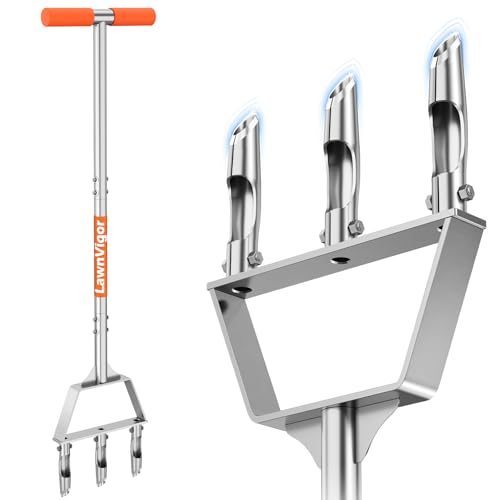
The LawnVigor is the only core aerator in the set, and the lightest at 3.53 lb, which makes it the right shared tool for households where a teenager and a grandparent will both use it.
Best for: households sharing the tool between adults of different heights Skip it if: you need to cover more than a few hundred square feet at a time
This is a hand aerator, not a step-on model, and that changes what it is for. You push it into the ground by hand, one spot at a time, and each push pulls three hollow soil plugs. The listing calls the tines heat-treated and non-clogging, with a claimed ejection design that clears plugs as you work. At 3.53 lb with a compact 2.8 x 15 x 10 in frame, this is the lightest tool here and the easiest to swing between two users of very different heights and strengths.
Because it removes soil rather than displacing it, this is the right tool for compacted lawns. The reason a first-time buyer might still hesitate is coverage. Three tines per push is nothing like sixteen spikes per step, so a large lawn becomes a weekend job instead of a morning one. On a small lawn, or for spot-fixing the compacted strip along a walkway, that is fine.
Two sellers list it, which is one more than most picks here.
Pros:
- Only core aerator in the set, pulls actual plugs
- Lightest tool here at 3.53 lb
- Compact 2.8 x 15 x 10 in dimensions for shared storage
- Two sellers list it
- LawnVigor calls the tines heat-treated and non-clogging
Cons:
- Three tines per push means slow coverage on large lawns
- Premium price position for a hand tool
- No published weight capacity or handle diameter
- Not a step-on design, so the technique is different
3. Walensee GT-LCA006 — Best for heavy use
The Walensee has the smallest published footprint of any step-on aerator here at 13.6 x 3.62 x 1.54 in, which makes it the one to reach for when you are working narrow strips and edges.

Best for: spot-aerating narrow strips and bare patches Skip it if: you want a self-cleaning spring mechanism
Fifteen iron spikes, powder-coated finish, and a compact head are what the Walensee brings. Walensee describes the tool as ideal for small-area lawn care and spot aeration, and the published dimensions back that up: the head is narrower than the Grenebo's, which is the difference between fitting a step between two shrubs and stopping short of them.
Walensee says the tines are about 2 in long, though the feature text is cut short in the listing so the exact figure is worth confirming on the product page. The build is described as heavy-duty iron with a rust-resistant coating, and the tool sells faster than any other pick in this set, which is a signal about how reliably it turns up in shopping carts.
What it does not have is a published self-cleaning mechanism. On damp soil, that means pausing to knock the spikes clean now and then. That is the trade-off against the Grenebo's spring claim.
Pros:
- Compact 13.6 x 3.62 x 1.54 in footprint for edges and narrow strips
- Fifteen sharp iron spikes with powder-coated finish
- Sells faster than the rest of this set
- Walensee positions it for spot and small-area aeration
- Second-cheapest here
Cons:
- No published tool weight, which matters on a step-on aerator
- No self-cleaning spring mechanism in the description
- Only one seller lists it
- Feature bullets on tine length are truncated in the listing
4. Saker X72945 — Best premium
The Saker sits at the top of the price ladder in this set and puts the money into a described double-layer spring and a thickened iron frame.

Best for: a beginner who wants the sturdiest build in this set Skip it if: you are the cost-conscious buyer of the group
Fifteen spikes at a claimed 2.3 in, a described double-layer spring system that ejects soil as you step, and dimensions of 4.7 x 15.7 x 12.6 in put the Saker in the same working class as the Grenebo, one spike short of it. Saker describes the frame as thickened iron with a rust-resistant coating. If the double-spring claim holds up in wet conditions, this is the one that keeps the spikes clearest of clay as you work.
The catch is what the listing does not publish. No tool weight is given, which is the single most important spec on a step-on aerator. The buyer is being asked to pay the highest price in this set without seeing that figure. Two sellers list it, which is a mild positive for availability.
The Saker is the slowest seller of the six by a wide margin. That is not a reason to avoid it, but combined with the missing weight figure, it makes the Grenebo the safer default at this level of experience.
Pros:
- Described double-layer spring for automatic soil ejection
- Rust-resistant coating on thickened iron
- Fifteen spikes at a claimed 2.3 in each
- Two sellers list it
- Full dimensions published
Cons:
- No published tool weight
- Highest price in this set
- Slowest seller of the five picks here
- Premium position without extra published capability over the Grenebo
5. RIFPOD STQ-009 — Best compact
The RIFPOD is the only pick with a described height-adjustable handle, ranging from 32 in to 35 in, which is exactly what a shared household needs.

Best for: shared households where users are different heights Skip it if: you want fully published dimensions before you buy
Fifteen spikes at a claimed 1.74 in each, a described dual-layer spring that clears soil and leaves, and an adjustable handle. That handle is the reason to look here. Everyone else in this set ships with a fixed shaft, which means a 5-foot-2 gardener and a 6-foot-1 gardener are working at different angles from the same wrists. The 32-in to 35-in adjustment on the RIFPOD is not huge, but it is more than any other pick offers.
Two things temper the enthusiasm. The published dimensions in the listing read as 1 x 1 x 1 in, which is a data entry issue rather than a real spec, and the tool weight is not listed either. So the case for this aerator rests on the described spike length, the described spring mechanism, and the adjustable handle, and you cannot check the frame footprint before it arrives.
It sits mid-priced in this set. Two sellers stock it.
Pros:
- Adjustable handle from 32 in to 35 in
- Described dual-layer spring for cleaning between steps
- Fifteen spikes at a claimed 1.74 in
- Two sellers list it
- Mid-priced in this set
Cons:
- Published dimensions in the listing look like a data error
- No published tool weight
- Shortest spike claim of the step-on picks
- Requires assembly before first use
How compacted is your soil, really?
Before you spend anything, do the screwdriver test. Push a long-shaft screwdriver into your lawn on a dry day. If it goes in six inches with light pressure, your soil is fine and a spike aerator will help. If it stops at two or three inches and you have to lean on it, you have compaction, and a core aerator is the honest answer.
That test alone tells you which of these five picks is right for your yard. It also tells you whether you should be aerating annually or every two to three years.
Here is what compaction looks like in practice:
- Water pools on the lawn after moderate rain and takes hours to soak in.
- Grass thins in high-traffic paths even when you fertilise.
- Moss creeps in on shaded sections.
- The lawn goes brown fast during a dry week even though neighbours' lawns hold up.
Any two of those signs and you need to pull cores, not punch spikes. The LawnVigor is the pick that does that in this set. The four spike aerators are for maintaining a lawn that is already breathing, not rescuing one that has stopped.
Aerating dry, hard soil is what breaks tools and wrists. Water the lawn the day before, or wait until a day after real rain. The listings for the Saker and Grenebo both refer to preparation and moisture; the point holds for every pick here.
What the listings do not tell you about aerating
Five things every one of these listings leaves out.
- Timing matters more than tool. Cool-season grasses like fescue and bluegrass want aerating in early fall or spring. Warm-season grasses like Bermuda and Zoysia want aerating in late spring or early summer. Aerating at the wrong time can stress grass that is already struggling.
- Overseed the same day. Aeration opens holes that let seed reach soil. Leaving those holes empty for a week wastes half the work.
- Do not aerate a new lawn. Wait a full growing season after sod or seed before you punch any holes.
- Mark the sprinkler heads first. Every year, someone destroys a pop-up with a spike aerator. Flag them before you start.
- Wet, not soaked. Spikes and tines slide into moist soil and slam into dry soil. They also cake in mud. The window is a day after real rain, not during it.
None of the five listings walks through this. That is not the tool's job. It is yours to know before you start.
When should a beginner skip a manual aerator entirely?
Two situations. First, if your lawn is larger than about five thousand square feet, a manual step-on tool becomes a serious afternoon of work and you should look at a rental core machine from a local hardware store instead. Rentals cost a fraction of what a lawn service charges and cover a big yard in an hour.
Second, if you have significant back or knee issues, no step-on manual aerator is friendly. The LawnVigor hand aerator is easier on the body than the four step-on picks, but even that involves repeated bending and pushing. Motorised rental machines take the physical load out of it.
For a small suburban lawn, though, a manual aerator is exactly the right entry point. It costs a fraction of a rental, stores in a corner of the garage, and comes out once a year for a job that takes an hour or two.
The verdict
Two tracks. If you have a normal suburban lawn on drained soil and this is your first aerator, the Grenebo AL001 is the pick. Sixteen spikes in a 4×4 layout means fewer steps to cover the yard, 6.61 lb of frame drives the spikes without stomping, and the cheapest price in this set makes the entry easy. Full dimensions of 35.4 x 5.91 x 11.8 in tell you exactly what you are getting. Grenebo's described self-cleaning spring is the finishing touch.
If your soil is compacted clay, that all changes. You need plugs pulled, not holes punched, and the LawnVigor is the only core aerator here. At 3.53 lb with three heat-treated hollow tines, it is slow across a big lawn but honest about the work it does, and it is the right tool for a family sharing between different heights and strengths.
The cutoff is the screwdriver test. If a long screwdriver slides six inches into your lawn on a dry day, go Grenebo. If it stops at three, go LawnVigor.
FAQ
Is a lawn aerator worth it for a small lawn?
A lawn aerator is worth it for a small lawn if the grass is thinning, water pools after rain, or moss is creeping in. On a healthy small lawn with drained soil, aerating every two to three years is enough. The Grenebo AL001 at 6.61 lb and 16 spikes covers a small lawn in one session, which is why it earns the beginner pick here.
What is the difference between a spike aerator and a core aerator?
The difference between a spike aerator and a core aerator is what happens to the soil. Spike aerators like the Grenebo, Walensee, Saker, and RIFPOD punch holes and displace soil sideways. Core aerators like the LawnVigor remove small cylinders of soil, which relieves compaction properly. On clay, cores win. On sandy or loamy soil, spikes are enough.
Can I use a manual aerator on wet grass?
You can use a manual aerator on moist grass, and it works better that way. Wait a day after real rain, not during it. Soaked ground turns to mud around the spikes and the tool cakes up. Dry ground refuses the spikes and jars your wrists. Aim for the soil to give under a screwdriver with light pressure but not squelch under your shoes.
Grenebo AL001 or LawnVigor: which should I buy?
Between the Grenebo AL001 and the LawnVigor, choose by soil type. The Grenebo has 16 spikes, weighs 6.61 lb, and covers ground fast on drained soil. The LawnVigor has three hollow tines, weighs 3.53 lb, and pulls actual plugs from compacted clay. Do the screwdriver test on a dry day: if it slides in easily, Grenebo. If it fights you, LawnVigor.
What is the biggest mistake beginners make with lawn aerators?
The biggest mistake beginners make with lawn aerators is aerating at the wrong time. Cool-season grasses want early fall or spring. Warm-season grasses want late spring or early summer. Aerating in summer heat or winter dormancy stresses grass that is already struggling and wastes the effort. The second mistake is skipping the overseed: aeration opens perfect seed beds, and leaving them empty throws away half the value.
Start with the screwdriver test this weekend, then match the tool to what the soil tells you. On a normal suburban lawn where the grass is mostly healthy but tired, the Grenebo AL001 is the low-risk, low-cost entry point that will do real work without leaving you sore. On compacted clay, the LawnVigor is worth the slower pace because pulling cores is the only aeration that actually relieves compaction. Either way, water the lawn the day before, flag the sprinkler heads, and keep a bag of grass seed ready. The tool is the small decision. The timing and the follow-up are what turn one afternoon into a better lawn next spring.