Best Heavy Duty Front Tine Tiller for Hard Clay Soil

Five gas tillers compared for compacted clay and new ground, with a 212cc front-tine winner and clear picks for smaller plots, tight budgets, and rear-tine buyers.

By Dane JonesUpdated 15 min read
On this page
- Best heavy duty front tine tiller at a glance
- How the shortlist was cut
- Front tine or rear tine for hard ground?
- 1. Mutaomay 212cc Gas Powered Garden Tiller Cultivator — Best overall
- 2. EARTHQUAKE Victory Rear Tine Tiller — Best premium
- 3. BILT HARD 24'' 99cc 4-Cycle Gas Tiller Cultivator — Best for heavy use
- 4. Earthquake 20015 Versa 2-in-1 Tiller Cultivator — Best for beginners
- 5. TAZZ 35310 2-in-1 Front Tine Tiller/Cultivator — Best budget pick
- What the tine width figure actually tells you
- How deep does a heavy duty front tine tiller really need to go?
- What owning a gas tiller actually involves
- The verdict
- FAQ
The best heavy duty front tine tiller for hard clay soil is the Mutaomay 212cc Gas Powered Garden Tiller Cultivator, which pairs a 212cc 4-stroke engine with a 21-inch tilling path and forward-and-reverse drive. At 130 lb it sits heavy on the tines, which is what you want in compacted ground. If you'd rather have counter-rotating tines and a cast-iron transmission, the 154 lb Earthquake Victory rear tine is the pick, with a 16-inch row and up to 10-inch depth.
Best heavy duty front tine tiller at a glance
| Pick | Engine | Tilling width | Weight | Price |
|---|---|---|---|---|
| 212cc 4-stroke | 21 in (claim: 22 in) | 130 lb | Check Price | |
Best premium EARTHQUAKE Victory Rear Tine Tiller |
209cc 4-cycle Viper | 16 in (rear tine) | 154 lb | Check Price |
Best for heavy use BILT HARD 24'' 99cc Gas Tiller Cultivator |
99cc 4-cycle | 17 to 24 in | 51 lb | Check Price |
Best for beginners Earthquake 20015 Versa 2-in-1 Tiller |
99cc 4-cycle Viper | 11 to 21 in | 78 lb | Check Price |
Best budget pick TAZZ 35310 2-in-1 Front Tine Tiller |
79cc 4-cycle Viper | 11, 16 or 21 in | not listed | Check Price |


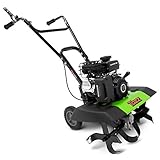
How the shortlist was cut
I lined up every gas tiller in the set and cut on three criteria in order. First, the layout: a front tine machine has to earn "heavy duty" through engine size, weight, and tine width, because it doesn't have the mechanical advantage of counter-rotating rear tines. Second, published working depth or tilling width: a tiller that hides both figures can't be compared. Third, whether the transmission or drive is described at all.
That left three genuine front tine picks: the Mutaomay 212cc, the BILT HARD 24" 99cc, and the TAZZ 35310. The Earthquake Versa 20015 is a front tine but sits at the light end at 78 lb, so it earns the beginner slot rather than the outright win. The Earthquake Victory is a rear tine machine, not a front tine, and I've kept it in as the honest comparison for anyone who typed "front tine" but has clay hard enough that the layout is the wrong question.
Two things I refused to guess: horsepower conversions for engines quoted only in cc, and any comment on noise or vibration. Neither figure appears in the listings.
Front tine or rear tine for hard ground?
Front tine tillers drive through the tines themselves: the spinning blades pull the machine forward while they cut. That's efficient in worked soil and cheaper to build, but in compacted clay the tines skate across the surface until the operator's weight and the engine's weight force them in. Heavy duty front tine tiller buyers usually solve this by choosing the heaviest machine they can push.
Rear tine tillers, like the Earthquake Victory, drive the wheels separately and let the tines cut behind. Counter-rotating tines (CRT) turn opposite to the wheels, which Earthquake says is what breaks "tough clay, compacted soil, and new ground." That's a manufacturer claim, not a lab result, but the mechanical logic is sound.
Here's the practical cutoff. If you're breaking sod or virgin clay once and then maintaining the plot, a heavy front tine like the 130 lb Mutaomay does the job and costs less to store. If you're breaking new ground every year across a bigger plot, the rear tine layout earns its keep. Below that threshold, the extra weight and cost of a rear tine are wasted.
1. Mutaomay 212cc Gas Powered Garden Tiller Cultivator — Best overall
A 212cc engine, a 21-inch tilling path and 130 lb of downforce make this the front tine pick to beat in hard soil.
Best for: breaking new ground in a mid-sized vegetable plot with hard or clay soil Skip it if: you need a machine light enough to lift into a car boot alone
Within this set the Mutaomay wins on the two figures that decide a heavy duty front tine tiller: engine displacement and machine weight. The 212cc 4-stroke is more than twice the displacement of the 99cc engines on the BILT HARD and the Earthquake Versa, and at 130 lb it's the heaviest front tine here by 52 lb over the Versa and 79 lb over the BILT HARD. Weight matters because a front tine machine has to press the tines into compacted ground, and there's no substitute for mass.
The 21-inch tilling width matches the widest setting on the Versa and the TAZZ, so you're not paying the engine premium for a narrower cut. Mutaomay says the forward and reverse transmission helps in raised beds and tight rows, which is a genuine advantage over single-direction drives at this price position. The dimensions are 55 x 37 x 21 in.
Two honest trade-offs. The listing is thin on transmission detail: no published warranty, no gear material, no depth figure. And at 130 lb it's the heaviest to store and transport in this front tine group.
Pros:
- 212cc 4-stroke, largest engine in the set
- 130 lb of downforce for compacted soil
- 21 in tilling path matches the widest here
- Forward and reverse drive
- Mid-range position among the five
Cons:
- No published warranty
- No published tilling depth
- Heaviest of the three front tine picks
2. EARTHQUAKE Victory Rear Tine Tiller — Best premium
The most expensive pick here, and the one to buy if you'd rather have counter-rotating tines and a cast-iron transmission than a front tine layout.

Best for: buyers who want counter-rotating tines and a cast-iron transmission for years of clay work Skip it if: you specifically want a front tine layout
The Victory is the only rear tine in the set and, at 154 lb, the heaviest machine here. It's included because a shopper typing "heavy duty" often really means "will finish the job in clay," and the rear tine layout is the mechanical answer to that question when a front tine machine keeps skating. Earthquake says the counter-rotating tines "turn the opposite direction of the wheels to break tough clay, compacted soil, and new ground," and describes a heavy-duty cast-iron transmission with engineered bronze gears.
The published figures are a 16 in row and up to 10 in depth. That's narrower than the Mutaomay's 21 in, so you make more passes on a wide bed. In exchange you get the Instant Reverse handle for tight spaces near fences, a 3-position adjustable handlebar, and a 5-year limited warranty. Dimensions are 48 x 54 x 23 in, and the machine was released in 2022.
The trade-offs are real. It's the most expensive pick here, it's rear tine (which is a different tool, not a better front tine), and it's the heaviest to wrestle in and out of a shed.
Pros:
- Counter-rotating tines for compacted clay
- Cast-iron transmission with bronze gears (Earthquake claim)
- Instant Reverse handle
- 5-year limited warranty, matching the Versa
- Up to 10 in tilling depth
Cons:
- The most expensive pick here
- Rear tine, not front tine
- 154 lb makes storage awkward
- 16 in row is narrower than the front tine picks at 21 in
3. BILT HARD 24'' 99cc 4-Cycle Gas Tiller Cultivator — Best for heavy use
The widest published tilling path in the set at 24 in, with an 11.8 in maximum working depth, at the second-cheapest price position.

Best for: long sessions where an 11.8 in working depth and 24 in path matter more than raw engine size Skip it if: you're breaking virgin clay in a single pass
BILT HARD publishes the two figures most tiller listings hide: a working depth up to 11.8 in and an adjustable width from 17 to 24 in. That 24 in path is 3 in wider than anything else in this comparison, and 11.8 in of depth beats the Victory's 10 in on paper. For a heavy duty front tine tiller buyer whose main problem is covering ground, that combination is the reason to pick it.
The 99cc 3HP EPA-certified engine runs at 3600 RPM and is the same displacement as the Earthquake Versa's, so this is a lighter, wider machine at a lower price position rather than a bigger-engined one. The dual-action safety system stops the tines when the clutch grip is released. The handle has three height settings and the 8-inch rear wheels are vertically adjustable in two positions for transport.
Weight is the honest trade. At 51 lb it's less than half what the Mutaomay puts on the tines, which is the physics that decides whether a front tine cuts hard-packed clay or bounces across it. Buy this for depth and width in already-worked soil, not for breaking new ground.
Pros:
- 11.8 in maximum working depth
- 24 in maximum tilling width, widest here
- Adjustable width down to 17 in
- Three-height handle, two-position wheels
- Second-cheapest of the five
Cons:
- 51 lb is light for compacted virgin ground
- 99cc engine is small versus the Mutaomay's 212cc
- No published warranty
4. Earthquake 20015 Versa 2-in-1 Tiller Cultivator — Best for beginners
The safest first tiller in the set: 99cc 4-cycle Viper engine, adjustable 11 to 21 in width, and a 5-year limited warranty.

Best for: first-time tiller owners who want a 5-year warranty and adjustable tilling width Skip it if: you have more than a quarter-acre of compacted ground to break
The Versa is the friendliest machine here for someone who has never run a tiller. Tool-less removal of the side shields and outer tines shrinks the tilling width from 21 in down to 11 in, so the same machine seedbeds a new row and then cultivates between growing plants. Earthquake publishes an 11 in tilling depth, which is respectable, and the 99cc 4-cycle Viper engine is the same family as the flagship Victory.
At 78 lb it's the middle weight of the front tine group: heavier than the 51 lb BILT HARD, lighter than the 130 lb Mutaomay. That's a fair compromise for a first-time buyer, because it's enough weight to bite in worked soil without being unwieldy in the shed. Dimensions are 34 x 50 x 24 in. The 5-year limited warranty matches the Victory and beats every other pick in the set that publishes one.
The trade-off is the price position. This is the second-most expensive pick here, and you're paying for the warranty and the 2-in-1 versatility rather than for more engine or more weight. If you already know you need a heavy machine for clay, the Mutaomay gets you more tiller for less money.
Pros:
- 5-year limited warranty
- Adjustable 11 to 21 in tilling width
- 11 in tilling depth
- Tool-less shield and tine removal
- Familiar Viper engine platform
Cons:
- Second-most expensive pick here
- 78 lb is light for virgin clay
- Small 99cc engine versus the Mutaomay's 212cc
5. TAZZ 35310 2-in-1 Front Tine Tiller/Cultivator — Best budget pick
The cheapest of the five, with three tilling widths (11, 16 and 21 in) and a forged-steel tine set.

Best for: raised beds and existing garden rows where a 79cc engine is plenty Skip it if: you're breaking hard-packed sod from scratch
The TAZZ is the entry point into this set and the machine to pick if the plot is already worked and you just need to fluff it every spring. The 79cc 4-cycle Viper engine is the smallest here but it's the same Viper family used across the Earthquake range, and TAZZ says the forged-steel tines handle "all kinds of soil conditions." Tool-less removal of the outer tines and side shields switches it between 21 in for seedbeds and 11 in for row cultivation, with a 16 in middle setting.
TAZZ makes a point of the low centre of gravity for stability, which is a real advantage on a light front tine machine that would otherwise skip. The listed 3-year limited warranty is shorter than the 5-year cover on the two Earthquake machines but longer than the Mutaomay and BILT HARD, which publish none. Dimensions are 35.5 x 51.2 x 24 in.
Two honest weaknesses. The weight isn't published, so I can't tell you exactly how much downforce the tines get. And a 79cc engine is a step down from the 99cc, 209cc and 212cc engines above it, so this is a maintenance machine, not a ground-breaker.
Pros:
- Cheapest pick in the set
- Three tilling widths: 11, 16 and 21 in
- Forged-steel tines (TAZZ claim)
- 3-year limited warranty
- Low centre of gravity for stability
Cons:
- Smallest engine at 79cc
- Weight is not listed
- The slowest seller of the five
What the tine width figure actually tells you
Most guides compare tillers by engine cc. That's not what decides the day. Two figures do more work: tine width and machine weight.
- Tine width is how much ground you turn per pass. A 21 in path finishes a 42 in raised bed in two passes; a 16 in path takes three. Across half an acre, that adds up to real time.
- Machine weight is what forces the tines into hard soil on a front tine layout. The tines don't have any independent downforce; they only bite because the machine's mass pushes them.
- Depth matters less than either, because most vegetable roots don't need more than 8 in of loose soil, and every tiller in this set exceeds that.
That's why the 212cc Mutaomay wins overall despite not publishing a depth figure: it has the widest published path in the front tine group at 21 in and the most weight at 130 lb, which is the combination that decides hard-soil work. The BILT HARD's 24 in path is wider on paper, but at 51 lb it lacks the mass to hold that width in compacted ground.
How deep does a heavy duty front tine tiller really need to go?
Deep enough for the crop, and not much more. Here's what the published figures in this set look like against typical planting requirements:
- Salad and shallow-rooted herbs: 4 to 6 in. Any tiller here handles it.
- Root vegetables (carrots, beets): 8 to 10 in. The Versa's 11 in and the BILT HARD's 11.8 in are comfortable; the Victory's 10 in is enough.
- Deep bed preparation for perennials: 10 to 12 in. The BILT HARD's 11.8 in is the deepest published figure in the set.
Skip the trap of chasing maximum depth for its own sake. A tiller that runs 12 in deep in loose loam won't get there in clay without weight and horsepower behind it, which is why the Mutaomay's 130 lb matters more than a published depth number on a lighter machine. And repeatedly tilling deep destroys soil structure; most seasoned growers till shallow after year one.
What owning a gas tiller actually involves
A gas tiller isn't a plug-in tool. Plan for the following before you buy:
- Fresh fuel and oil. All five picks run 4-cycle engines, which take separate gasoline and oil, not a pre-mix. Ethanol-heavy pump fuel breaks down in weeks, so buy small quantities and use them.
- Storage space. The Mutaomay is 55 x 37 x 21 in and 130 lb. The Victory is 48 x 54 x 23 in and 154 lb. Measure the shed door before, not after.
- Transport. Even the 51 lb BILT HARD needs a truck bed or a folded rear seat. Nothing in this set breaks down small enough to fit in a hatchback boot without help.
- End-of-season care. Drain or stabilise the fuel, wipe the tines, check the oil. Skipping this is the single most common reason a tiller won't start in spring.
None of that is a reason not to buy one. It's a reason to buy the machine that fits the plot, so you use it enough to justify the storage.
The verdict
For breaking hard or clay soil on a mid-sized plot, the Mutaomay 212cc Gas Powered Garden Tiller Cultivator is the right heavy duty front tine tiller. The 212cc engine is more than twice the displacement of the next-largest front tine here, the 130 lb weight is what actually forces the tines into compacted ground, and the 21 in tilling path matches the widest cut in the set. Forward and reverse drive is a genuine convenience in tight rows.
Two conditions flip the choice. If your soil is genuinely brutal, or you're breaking sod every year on a bigger plot, buy the Earthquake Victory instead: counter-rotating tines and a cast-iron transmission with a 5-year limited warranty are the correct tool for that job, even though it's rear tine and the most expensive pick here. If you already have worked soil and just want the widest cut and deepest published depth for long maintenance sessions, the BILT HARD takes 24 in in one pass and reaches 11.8 in down, at the second-cheapest position in the set.
The cutoff is soil condition: virgin ground and clay push you to weight and displacement; worked ground rewards width and depth.
FAQ
Is a front tine tiller heavy duty enough for clay soil?
A front tine tiller is heavy duty enough for clay when it has enough weight to press the tines in, which is why the 130 lb Mutaomay is the pick here rather than the 51 lb BILT HARD. Below roughly 100 lb, a front tine machine tends to skate on truly compacted clay, and a rear tine with counter-rotating tines, like the Earthquake Victory, becomes the right tool.
How much engine does a heavy duty front tine tiller actually need?
How much engine you need depends on soil and plot size, not on chasing the biggest number. For maintaining worked soil, the 79cc TAZZ or 99cc BILT HARD is plenty. For breaking new ground or clay, the 212cc Mutaomay is a step up in displacement that matches the step up in weight, and the two figures work together: a big engine on a light frame won't dig any deeper than the frame allows.
Mutaomay 212cc or Earthquake Victory for compacted ground?
The Mutaomay 212cc or Earthquake Victory choice comes down to layout. The Mutaomay is a front tine machine at 130 lb with a 21 in path and forward-reverse drive, cheaper and simpler. The Victory is rear tine with counter-rotating tines Earthquake designed for tough clay, a cast-iron transmission and a 5-year warranty, but a 16 in row and a higher price. Pick the Mutaomay for value, the Victory for the hardest ground.
Is a 2-in-1 front tine tiller worth it?
A 2-in-1 front tine tiller is worth it if you cultivate between rows during the growing season, not just prepare beds in spring. The Earthquake Versa and TAZZ 35310 both drop from 21 in down to 11 in by removing the outer tines and side shields with no tools, which lets one machine seed a bed and then work between the plants six weeks later. If you only ever prep beds, you don't need the feature.
What tilling width fits a standard raised bed?
What tilling width fits a standard raised bed depends on the bed size, but a 4 ft wide raised bed takes two passes at 21 in or three at 16 in. The 24 in BILT HARD does a 4 ft bed in two clean passes with a small overlap. Narrower rows between planted crops need the 11 in cultivator setting on the Versa or the TAZZ, so a 2-in-1 machine is genuinely useful here.
Start by looking at the plot rather than the spec sheet. If the ground is hard or has never been worked, weight and displacement matter more than any other figure, and the Mutaomay 212cc is the front tine tiller that puts both on the tines. If the soil is already worked and you're planning a season of maintenance and cultivation, the BILT HARD's depth and width, or the TAZZ's three-width flexibility at the entry price position, will feel like the smarter buy. The best heavy duty front tine tiller is the one whose weight, width and drive match the ground you're actually standing on, and for most buyers breaking real soil, that's the Mutaomay.