Best Gas Tiller for Seniors: BILT HARD 46cc Leads

Seven tillers compared on the numbers that matter when strength and balance are the real limits: machine weight, handle adjustment, starting hardware and working width.

By Dane JonesUpdated 19 min read
On this page
- Best gas tiller for seniors at a glance
- How I scored these seven on weight, controls and reach
- Why engine size is the wrong number to compare
- 1. BILT HARD 46cc 4-Cycle 1.9HP Gas Powered Tiller Cultivator — Best overall
- 2. Honda FG110 Mini Tiller Cultivator — Best premium
- 3. LOVTILLER 12'' 15AMP Electric Roto Tiller for Gardening — Best budget pick
- 4. VEVOR Tiller Cultivator Gas Powered — Most versatile
- 5. Baotree 72CC Gas Tiller Cultivator — Best upgrade
- 6. BILT HARD 24'' 99cc 4-Cycle Gas Tiller Cultivator — Best minimal setup
- 7. Mutaomay 212cc Gas Powered Garden Tiller Cultivator — Best for pros
- How heavy is too heavy to steer?
- What does starting a gas tiller actually involve?
- When a different pick wins
- The verdict
- FAQ
The best gas tiller for seniors is the BILT HARD 46cc 4-Cycle, because its thumb throttle and power switch sit on a single one-hand control panel while the 16 in tine width still clears a real vegetable row. If you want the lightest gas machine in this group, the Honda FG110 weighs 28 lb and carries a 2-year residential warranty instead.
Most guides for this category compare engine displacement, and that is the wrong number. A 212cc engine sounds like the safe choice until you notice the machine around it weighs 130 lb. Displacement tells you how hard the tines bite. Weight, handle height and where the controls sit tell you whether you can hold the thing straight for twenty minutes. That is the comparison below.
Best gas tiller for seniors at a glance
| Pick | Working width | Weight | Price |
|---|---|---|---|
Best overall BILT HARD 46cc 4-Cycle Tiller Cultivator |
16 in (claim) | Not listed; 42.9 x 41.5 x 16 in body | Check Price |
Best premium Honda FG110 Mini Tiller Cultivator |
9 in, or 6 in with outer tines off (claim) | 28 lb | Check Price |
Best budget pick LOVTILLER 12'' 15AMP Electric Roto Tiller |
12 in (claim) | Not listed; 13.8 x 14.8 x 20.9 in body | Check Price |
Most versatile VEVOR 43CC Tiller Cultivator |
11.8 in (claim) | 33.1 lb | Check Price |
Best upgrade Baotree 72CC Gas Tiller Cultivator |
10 in (claim) | Not listed; 28 x 12.7 x 18 in body | Check Price |
Best minimal setup BILT HARD 24'' 99cc Gas Tiller |
17 to 24 in (claim) | 51 lb | Check Price |
Best for pros Mutaomay 212cc Garden Tiller Cultivator |
21 in (claim) | 130 lb | Check Price |




How I scored these seven on weight, controls and reach
I weighted four criteria, in this order, and the order is the argument.
- Published weight, 40%. It is the single figure that predicts whether a machine gets used twice or once. Three of the seven publish it: 28 lb, 33.1 lb and 51 lb. One publishes 130 lb.
- Control layout, 25%. A thumb throttle you reach without letting go beats a lever you have to hunt for. Two listings describe a one-hand or handle-mounted control cluster.
- Handle and wheel adjustment, 20%. Three height settings mean you set the grip to your own posture instead of stooping to the machine's.
- Working width, 15%. Last, deliberately. A wide path saves passes, but a wide tine set also fights back harder in the turn.
Two things pushed picks down the list. A machine that publishes no weight anywhere in its specifications loses points, because you cannot plan a lift you cannot size. And a machine whose only real advantage is engine displacement loses points too, since displacement is the least useful figure here.
A note on the search itself, because it matters. Amazon does not filter tillers for age or strength, so no listing in this group is built, marketed or certified for older users. Nothing below is a senior-specific product. What I have done instead is rank general-purpose machines against the physical demands that actually matter, and you are the one who has to judge your own grip strength, balance and shoulder reach against the figures.
Why engine size is the wrong number to compare
Here's the trick with the best gas tiller for seniors: the displacement figure on the box is a measure of the fight the machine will put up, not the ease with which you will win it.
Run the numbers in this set. The Mutaomay carries a 212cc four-stroke and weighs 130 lb. The Honda FG110 uses the GX25 and weighs 28 lb. That is roughly a fourfold difference in mass for a machine doing the same basic job in a home garden. The heavier one tills 21 in per pass by the listing's claim, against 9 in for the Honda. So you buy about twice the path for four times the weight.
Three figures predict comfort better than displacement:
- Weight. Every pound has to be lifted into a truck bed, walked across a lawn and held straight when a tine hits a root.
- Tine width. Wider tines generate more torque reaction at the handles. A 24 in span pulls harder sideways than a 10 in span.
- Handle height settings. Both BILT HARD models and the Baotree claim three positions. Fixed handles force your posture to match the machine.
Depth is the one place where more is not always better. The BILT HARD 24'' claims a range from 3.94 in for weeding up to 11.8 in for deep preparation. Set it shallow and it behaves like a much smaller machine. Set it to 11.8 in in dry clay and it will try to walk away from you.
1. BILT HARD 46cc 4-Cycle 1.9HP Gas Powered Tiller Cultivator — Best overall
A 16 in path with a genuine one-hand control panel, which is the combination nothing else here matches.
Best for: a home gardener who wants one-hand throttle control and a 16 in path Skip it if: you need to till a plot measured in acres
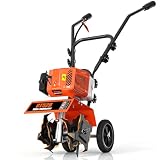
Within this group, the differentiator is the control panel. BILT HARD says the thumb throttle and the power switch are combined into a single-hand cluster, which means your other hand stays where it belongs, steadying the handlebar. Every other gas machine here splits those functions across two grips.
The engine is a 46cc four-stroke, and BILT HARD claims 1,400W peak at 9,200 RPM. Four-stroke matters more than the numbers do: you fill it with straight gasoline instead of measuring two-stroke mix on a garage bench. The listing describes 6 forward-rotating steel blades and 4 angled tines reaching a 16 in width and 8 in depth. Starting hardware includes an automatic reset choke lever and a compression release, both aimed at reducing pull-cord effort.
The wheels adjust and the grips are cushioned, per the listing. Body dimensions are 42.9 x 41.5 x 16 in, so it stores against a garage wall rather than in a corner.
The trade-off is information. BILT HARD does not publish a weight for this model, and unlike the Honda it lists no warranty term. You are trusting the design description more than the specification sheet.
Pros:
- Thumb throttle and power switch on one control panel
- 16 in working width, widest of the cultivator-class picks
- Four-stroke engine runs on straight gasoline
- Compression release and auto-reset choke for easier starts
- Adjustable wheels plus cushioned grips
Cons:
- No published weight anywhere in the specifications
- No stated warranty, unlike the Honda pick
- Only one seller lists it
- 8 in depth is fixed, with no shallow weeding setting
2. Honda FG110 Mini Tiller Cultivator — Best premium
At 28 lb with a 2-year residential warranty, it is the lightest gas machine here and the only one with warranty terms on the page.

Best for: someone who wants the lightest gas machine with a published warranty Skip it if: you need a wide path through hard, unbroken ground
Two figures separate the FG110 from everything else. It weighs 28 lb, which is 5 lb under the VEVOR and 23 lb under the BILT HARD 24''. And it lists a 2-Year Residential Warranty, the only warranty term published across all seven listings.
The engine is the Honda GX25 four-stroke, described in the listing as quick and easy to start and running on straight gasoline. Tine width is where you pay for that lightness: 9 in in standard configuration, or 6 in with the outer tines removed for tight spots. Honda describes the tines as a patented hybrid design that digs and cultivates. There is an adjustable depth bar for controlling depth and pace, plus two-position transport wheels for rolling it over smooth or rough ground.
At 16 x 25 x 23 in it is the second-smallest body here. That matters for storage and for getting it through a garden gate.
The honest loss is coverage. This is the most expensive pick in the set and it tills a 9 in path, less than half the BILT HARD 24''. For a 40-foot row you will make several more passes. Buy it for handling, not for throughput.
Pros:
- 28 lb, the lightest gas machine in this comparison
- Only pick with a published warranty term, 2 years residential
- Tine width drops to 6 in for tight beds
- Adjustable depth bar controls depth and pace
- Compact 16 x 25 x 23 in body
Cons:
- Highest price position in the set for the narrowest gas path
- 9 in standard width means many more passes on a long row
- Reducing to 6 in requires physically removing outer tines
- Only one seller lists it
3. LOVTILLER 12'' 15AMP Electric Roto Tiller for Gardening — Best budget pick
The cheapest of the seven, and the only one with no pull cord, no fuel and no engine to start.

Best for: raised beds and small plots within cord reach of an outlet Skip it if: your garden is far from any outlet
This is the outlier, and it is here on purpose. It is corded electric, not gas, so it belongs in any honest discussion of the best gas tiller for seniors as the alternative that removes the hardest physical step. No pull cord, no choke, no fuel mixing, no winter carburettor trouble. You press a switch.
The motor is 15 amp and the tine width is 12 in, which sits above the Honda, the Baotree and the VEVOR. LOVTILLER describes 4 x 4 rust-proof steel angled tines and calls them replaceable. The wheel adjusts to two positions across a 6 in range for tilling or wheeling. There is an automatic stop mechanism the listing ties to hitting buried rocks and dense roots.
At 13.8 x 14.8 x 20.9 in it is the smallest body of all seven. It is also the one buyers here choose most often, and the only pick with more than one seller.
The cord is the whole argument against it. You manage a live cable behind you while walking a tiller forward, which is a genuine trip risk on uneven ground, and your working radius stops where the extension lead does. LOVTILLER publishes no weight either.
Pros:
- No pull cord, choke or fuel handling at all
- 12 in width beats three of the gas picks
- Cheapest of the seven
- Smallest body here, 13.8 x 14.8 x 20.9 in
- Automatic stop mechanism for buried obstructions
Cons:
- Cord limits range and adds a trip hazard underfoot
- No published weight
- Not a gas machine, so no untethered use
- No stated warranty term
4. VEVOR Tiller Cultivator Gas Powered — Most versatile
33.1 lb with handle-mounted switches and brakes, at the second-cheapest position in this group.

Best for: flower beds and vegetable rows where a narrow path helps Skip it if: you would rather not mix two-stroke fuel
The VEVOR sits in a useful gap. It is the second-cheapest pick, it publishes its weight at 33.1 lb, and VEVOR puts both the switches and the brakes on the handle so your hands stay in place. Only the Honda is lighter among the gas machines, and the Honda costs considerably more.
The engine is 43cc two-stroke. VEVOR claims four steel adjustable front tines working to 11.8 in wide and 3.9 in deep, and describes enlarged heat dissipation holes plus a high-quality air filter for continuous running. The listing also calls it a stand-up operation design and mentions a thickened, lengthened pull cord for more reliable starts. Assembly is described as three steps.
Body dimensions are 35.8 x 43.7 x 17.6 in. Colour is orange, which is easier to spot in tall growth than the blue or green machines.
Two real costs. Two-stroke means every tank needs oil mixed into the gasoline in the right ratio, a fiddly job with a measuring cup. And the 3.9 in depth is the shallowest here, less than half the BILT HARD 46cc's 8 in. Fine for beds you already work; thin for breaking new ground.
Pros:
- 33.1 lb published, second-lightest gas pick
- Switches and brakes both mounted at the handle
- Second-cheapest of the seven
- Three-step assembly per the listing
- Adjustable front tines
Cons:
- Two-stroke fuel must be mixed by hand every time
- 3.9 in depth is the shallowest in this comparison
- 11.8 in width means extra passes on wide rows
- No stated warranty; only one seller lists it
5. Baotree 72CC Gas Tiller Cultivator — Best upgrade
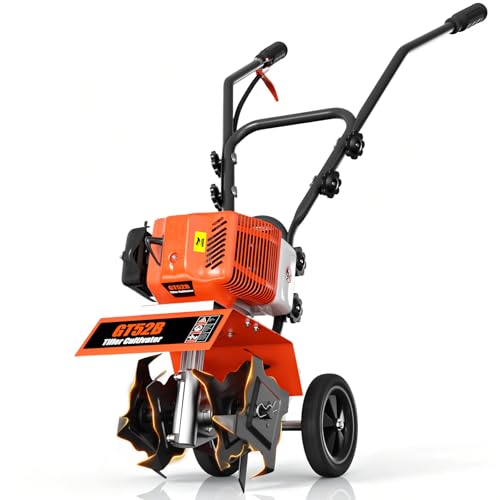
Three handle heights plus a stepless speed control from 0 to 0.25 m/s, so you set the pace instead of chasing the machine.
Best for: someone who wants three handle heights and a slow, controllable pace Skip it if: you want the widest possible path per pass
Speed control is the differentiator. Baotree claims a stepless operating speed from 0 to 0.25 m/s, adjustable to match soil hardness. Every other gas pick here gives you a throttle and a wish. Being able to dial the ground speed down to a crawl is the single most useful comfort feature in this group, because a tiller that outruns your walking pace is the one that gets away from you.
Baotree also lists three gears of height adjustment, and ties that directly to reducing lower-back fatigue over a long session. The engine is 72cc two-stroke, claimed at 1.5kW and 7500 RPM. Working width is 10 in with a 5 in maximum depth, and Baotree claims fuel use of 15 to 25 kg per hectare on regular gasoline.
At 28 x 12.7 x 18 in this is a genuinely compact body, second only to the LOVTILLER.
The gaps are real. No published weight, no warranty term, and a 10 in path that is narrower than five of the other six. It is also two-stroke, so hand-mixed fuel again.
Pros:
- Stepless speed control from a standstill to 0.25 m/s
- Three height positions, aimed at back fatigue
- Compact 28 x 12.7 x 18 in body
- Runs on regular gasoline
- Sits at the second-lowest price position
Cons:
- 10 in width, narrower than five of the other six picks
- Two-stroke engine needs mixed fuel
- No published weight or warranty
- Slowest-selling half of this set; only one seller lists it
6. BILT HARD 24'' 99cc 4-Cycle Gas Tiller Cultivator — Best minimal setup
Width swings from 24 in to 17 in and depth from 3.94 in to 11.8 in, so one machine covers weeding and deep bed preparation.

Best for: a large plot where width and depth adjust in one machine Skip it if: you cannot manage a 51 lb body on uneven ground
This is the range pick. BILT HARD claims the working width adjusts from 24 in down to 17 in and the depth from 3.94 in for weeding up to 11.8 in for deep soil preparation. Nothing else in this set spans both dimensions. Set shallow and narrow it works between rows; set wide and deep it breaks a new plot.
The engine is a 99cc four-stroke, listed as 3HP, EPA-certified and running at 3600 RPM. That lower RPM figure is worth noting next to the 9,200 RPM claim on the 46cc model, since it points to a torquier, calmer delivery. The handle adjusts to three heights, the 8 in rear wheels adjust vertically across two positions for transport and stable tilling, and BILT HARD describes a dual-action system where releasing the clutch grip stops tine rotation while a separate throttle switch shuts the system down.
Then the number that decides it: 51 lb, and a 43.3 x 51.2 x 24.1 in footprint. That is 23 lb heavier than the Honda and the largest body except the Mutaomay. A 24 in tine span also generates the most sideways pull of any cultivator here. It is the most expensive of the BILT HARD pair and asks the most of your shoulders.
Pros:
- Width adjusts 24 in to 17 in, depth 3.94 in to 11.8 in
- Three handle heights plus two-position 8 in rear wheels
- Four-stroke, EPA-certified, straight gasoline
- Clutch grip stops tines when released
- Widest path of the cultivator-class picks
Cons:
- 51 lb, heavier than every pick except the Mutaomay
- 24 in tine span pulls hard sideways in turns
- Largest footprint here at 43.3 x 51.2 x 24.1 in
- No stated warranty; only one seller lists it
7. Mutaomay 212cc Gas Powered Garden Tiller Cultivator — Best for pros
The only pick with reverse drive, and at 130 lb the only one that genuinely needs a second pair of hands.

Best for: acreage, food plots and hard clay with a helper on hand Skip it if: you will be working alone
Reverse is the feature nobody else offers. Mutaomay describes a forward and reverse drive system for manoeuvring through garden rows, raised beds and tight corners, and on a machine this size that is not a luxury. Turning 130 lb of tiller at the end of a row by lifting it is not realistic for most people. Backing it out is.
The engine is a 212cc four-stroke, the largest here by a wide margin, aimed at compacted ground and clay. Working width is 21 in with heavy-duty steel tines, and the handle is described as multi-position to fit different users and conditions.
I have ranked it last for this audience, and the weight is the whole reason. 130 lb is more than four times the Honda FG110 and 79 lb over the BILT HARD 24''. Body dimensions are 55 x 37 x 21 in, so it also needs real garage space and a ramp to move it. There is no published warranty and only one seller lists it. It is the slowest seller of the seven.
Buy it for a large plot where someone else can help load and unload. Do not buy it because 212cc sounds reassuring.
Pros:
- Only pick with forward and reverse transmission
- 212cc four-stroke, most engine here by a wide margin
- 21 in width covers ground fast
- Multi-position ergonomic handle
- Front-tine design for hard, compacted clay
Cons:
- 130 lb, over four times the lightest pick here
- 55 x 37 x 21 in demands garage space and a loading ramp
- No published warranty term
- Slowest seller of the seven; only one seller lists it
How heavy is too heavy to steer?
There is no certified threshold, so use the published figures as a ladder and pick your rung honestly.
- Under 30 lb. The Honda FG110 at 28 lb. You can lift it into a car boot alone and carry it through a gate.
- 30 to 40 lb. The VEVOR at 33.1 lb. Manageable to drag and tip, awkward to lift far.
- 40 to 60 lb. The BILT HARD 24'' at 51 lb. This is two-hands-and-a-plan territory, or a ramp.
- Over 100 lb. The Mutaomay at 130 lb. Assume you need help every single time.
The other half of the equation is torque reaction, and no listing publishes it. Wider tines twist the handlebars harder when they catch. So a 24 in machine at 51 lb can feel more demanding than a 12 in machine at the same weight. If your grip strength is the limiting factor rather than your back, narrow beats light.
Three of these seven publish no weight at all: both BILT HARD models, the Baotree and the LOVTILLER. For those, dimensions are the proxy you have. The LOVTILLER at 13.8 x 14.8 x 20.9 in is clearly a small machine. The BILT HARD 24'' at 43.3 x 51.2 x 24.1 in clearly is not.
What does starting a gas tiller actually involve?
This is the step that decides whether a machine gets used, and the listings differ sharply on it.
Pull-start effort. Every gas pick here starts with a recoil cord. Two listings address the effort directly. The BILT HARD 46cc claims an automatic reset choke lever and a compression release system, which reduces the resistance you pull against. VEVOR claims a thickened, lengthened cord for reliable starts. Honda's page leans on the GX25's reputation for quick starts.
Fuel handling. This splits the field cleanly. Four-stroke machines take straight gasoline: the two BILT HARD models, the Honda and the Mutaomay. Two-stroke machines need oil mixed into the fuel in a fixed ratio: the VEVOR and the Baotree. If measuring and mixing on a garage bench is a problem, that narrows your list to four.
No starting at all. The LOVTILLER is corded electric. You plug it in and press a switch. That is the only option here that removes the recoil cord completely, and it is the reason it earned a place in a gas roundup.
Stopping. The BILT HARD 24'' describes a clutch grip that halts tine rotation the moment you release it, with a separate throttle shutdown. The LOVTILLER claims an automatic stop when the tines meet a rock or dense root. On a machine you might lose your footing behind, the release-to-stop grip is the feature I would prioritise after weight.
When a different pick wins
Three conditions flip my recommendation away from the BILT HARD 46cc.
Your plot is under about 200 square feet, all raised beds, and there is an outdoor outlet. Then the LOVTILLER wins. A 12 in electric tiller with no cord to pull and no fuel to mix beats a 16 in gas machine you have to prime and start. The cord is a nuisance in a big yard and irrelevant in a small one.
Lifting is the hard part, not tilling. Then the Honda FG110 wins on its 28 lb and its 2-year residential warranty, and you accept the 9 in path as the price. It is the only listing here that puts a service commitment in writing.
You are breaking new ground over a large area and someone can help. Then the BILT HARD 24'' wins on its 24 in to 17 in width range and 11.8 in maximum depth, or the Mutaomay wins on 212cc plus reverse drive. Both ask more of you physically than they give back in comfort, which is exactly the trade you are making.
One condition that does not flip it: wanting more engine for its own sake. The 46cc four-stroke breaks garden soil, and the extra displacement above it buys width and weight together.
The verdict
The best gas tiller for seniors here is the BILT HARD 46cc 4-Cycle, and the reason is the control panel rather than the engine. Combining the thumb throttle and power switch into one single-hand cluster means one hand can stay on the bar at all times, and no other gas machine in this set does that. You also get a 16 in path with 8 in of depth, four-stroke simplicity on straight gasoline, adjustable wheels, cushioned grips and starting hardware built around a compression release. That is the widest capability in this group that still runs from one hand.
Two conditions change the answer. If lifting and carrying is the real barrier, the Honda FG110 at 28 lb is the machine to buy, and its 2-Year Residential Warranty is the only warranty term published across these seven listings. If your garden is small, bedded and near an outlet, the LOVTILLER removes the pull cord entirely at the lowest price position in the set.
The Honda's specific advantage over the winner is documented lightness. BILT HARD publishes no weight for the 46cc at all, so you are inferring its handling from its 42.9 x 41.5 x 16 in frame and its design description. Honda gives you 28 lb in print, plus warranty terms. If certainty about what you will be lifting matters more than a 16 in path, pay the difference.
FAQ
Is a gas tiller worth it compared with an electric one for a small garden?
A gas tiller is worth it when your plot is beyond extension-cord reach or you need to work several separate beds around a property. For a single raised bed near an outlet, the LOVTILLER's 12 in electric head does the job with no fuel, no choke and no pull cord. Gas buys freedom of movement, and that is mostly what it buys.
Which offers better value, the BILT HARD 46cc or the Honda FG110?
Better value between the BILT HARD 46cc and the Honda FG110 depends on which cost you care about. The BILT HARD sits mid-range and delivers a 16 in path with one-hand controls. The Honda is the most expensive pick and tills 9 in, but it publishes 28 lb and a 2-year residential warranty. Pay more for documented lightness and coverage; pay less for width.
How much does a gas tiller for seniors weigh in this comparison?
Weight in this comparison runs from 28 lb for the Honda FG110 to 130 lb for the Mutaomay 212cc, with the VEVOR at 33.1 lb and the BILT HARD 24'' at 51 lb. Three listings publish no weight at all. Where the figure is missing, use body dimensions as a rough guide to scale before you commit.
Do I need to mix fuel for these tillers?
You need to mix fuel for two of the seven. The VEVOR 43cc and the Baotree 72cc are two-stroke engines, so oil goes into the gasoline in a set ratio every time. The two BILT HARD models, the Honda FG110 and the Mutaomay are four-stroke and run on regular gasoline straight from the can. The LOVTILLER uses no fuel.
What is the most common mistake when buying a tiller like this?
The most common mistake is buying on engine displacement. A 212cc machine sounds safer than a 46cc one until you see it weighs 130 lb and needs a ramp. Match the width and weight to the plot and your own reach first, then check the engine is four-stroke if fuel mixing is a chore you would rather skip.
Start with the two figures on your own side of the transaction: how far you can comfortably walk a machine, and whether anyone can help you load it. Then read the width and weight columns above against those limits. The BILT HARD 46cc is the sensible default because it puts the throttle and switch under one thumb while still cutting a 16 in path, which is the balance most home gardeners actually need. Go lighter with the Honda if lifting is the sticking point, or drop the pull cord entirely with the LOVTILLER if your beds sit within cord reach.