Best Gas Mini Tiller for a Backyard Vegetable Plot

Six gas mini tillers compared on engine type, tilling width and weight, with a clear winner for backyard beds and honest picks for tight budgets and small spaces.

By Dane JonesUpdated 14 min read
On this page
- Best gas mini tiller at a glance
- How I screened these six down
- What actually decides a gas mini tiller?
- 1. Honda FG110 Mini Tiller Cultivator — Best overall
- 2. BILT HARD 46cc 4-Cycle Tiller Cultivator — Runner-up
- 3. VEVOR Tiller Cultivator Gas Powered — Best for heavy use
- 4. NuBusno 1.7HP Gas Powered Garden Tiller — Best for small spaces
- 5. EEYBLAEEY Gas Powered Mini Tiller — Best for beginners
- 6. SRTYGHW Gas Powered Garden Tiller — Best budget pick
- Two-stroke or four-stroke: which should you buy?
- How wide and deep do these really go?
- When a different pick wins
- The verdict
- FAQ
The best gas mini tiller is the Honda FG110, a 28 lb four-stroke cultivator that tills 9 inches wide and drops to 6 inches when you pull the outer tines. If your soil is harder and you want more bite, the BILT HARD 46cc claims a 16-inch working width and an 8-inch depth. Here is the quick shortlist: the Honda for reliability, the BILT HARD for width, and the SRTYGHW if you want the cheapest way in.
Best gas mini tiller at a glance
| Pick | Engine | Tilling width | Price |
|---|---|---|---|
Best overall Honda FG110 Mini Tiller Cultivator |
25cc 4-stroke | 9 in (6 in narrowed) | Check Price |
Runner-up BILT HARD 46cc Tiller Cultivator |
46cc 4-stroke | 16 in claim | Check Price |
Best for heavy use VEVOR Tiller Cultivator |
43cc 2-stroke | 11.8 in claim | Check Price |
Best for small spaces NuBusno 1.7HP Garden Tiller |
43cc 2-stroke | 9.8 in claim | Check Price |
Best for beginners EEYBLAEEY Mini Tiller |
52cc 2-stroke | 14 in claim | Check Price |
Best budget pick SRTYGHW Garden Tiller |
43cc 2-stroke | 9 in claim | Check Price |


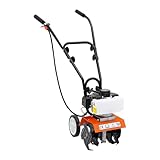
A note before the picks. The word "mini" is doing real work in this category, and not every tiller here fits it cleanly. The Honda and the smaller two-strokes are genuinely compact. The BILT HARD, at 42.9 inches long, is a bigger machine. I have flagged size honestly in each section so you can judge it against your own beds rather than the label.
How I screened these six down
I started with listing data only: engine type, tilling width, depth, weight, dimensions and warranty. Every figure below is copied from a listing, not measured by me. Where a spec was missing, I say so rather than guess.
Three things shaped the ranking:
- Engine type. Four-stroke engines take straight gas and tend to be easier on maintenance. Two-stroke engines need an oil-fuel mix. That single choice splits this field cleanly down the middle.
- Published, comparable specs. The Honda and the VEVOR carry weights, dimensions and, for the Honda, a warranty. Several of the budget entries publish width and depth as manufacturer claims only, with no weight at all.
- What "mini" really means. A true mini tiller moves easily and stores in a corner. I weighted compact dimensions heavily, which is why the largest machine here is a runner-up rather than the winner.
What survived is a spread from a proven four-stroke down to bare-bones two-strokes. What did not survive the wording test: any pick I could not describe accurately from its own listing.
What actually decides a gas mini tiller?
Most guides lead with horsepower or engine displacement. That is the wrong first question. A 52cc number looks bigger than 25cc, but engine size is not the same as usable performance, and the raw figure tells you nothing about how the machine feels in a narrow row.
The real deciding criterion is engine type paired with working width. Here is why.
- A four-stroke engine runs on plain gas and skips the fuel-mixing step. The Honda FG110 and the BILT HARD 46cc are the only two four-strokes in this set.
- A two-stroke engine is lighter for its power but needs a precise oil-fuel mix every time you fill up. The VEVOR, NuBusno, EEYBLAEEY and SRTYGHW all run two-stroke.
- Working width decides how the tiller behaves in real beds. A 9-inch cut, like the Honda's, threads between rows. A 16-inch cut, like the BILT HARD's claim, covers open ground faster but fights you in tight spots.
So the question is not "which has the biggest engine". It is "do I want to mix fuel, and how wide are my beds". Answer those two and the field narrows fast.
1. Honda FG110 Mini Tiller Cultivator — Best overall
The Honda FG110 wins because it pairs a proven 25cc four-stroke engine with a genuinely compact 28 lb body and the only stated warranty in the set.
Best for: backyard beds that need a reliable four-stroke engine Skip it if: you want the lowest price in the set
What sets the FG110 apart in this group is the combination of small size and a four-stroke engine. It weighs 28 lb and measures 16 x 25 x 23 in, so it stores in a corner and lifts into a car trunk without a struggle. Honda says the GX25 four-stroke engine is built for quick, easy starts, and because it is a four-stroke, you feed it straight gas with no mixing.
The tilling width is the clever part. In its regular setup the FG110 cuts 9 inches wide, and Honda says you can remove the outer tines to narrow that to 6 inches for tight beds. That flexibility is rare here. It also carries a 2-Year Residential Warranty, the only published warranty among these six.
The trade-off is price position. The Honda is the most expensive pick here, and its engine is the smallest by displacement. You are paying for the four-stroke reliability and the brand, not for raw cc.
Pros:
- Only pick with a stated 2-year warranty
- Compact 28 lb body, 16 x 25 x 23 in
- Four-stroke engine runs on straight gas
- Width adjusts from 9 in down to 6 in
Cons:
- The most expensive pick in this set
- Smallest engine displacement at 25cc
- Only one seller lists it
2. BILT HARD 46cc 4-Cycle Tiller Cultivator — Runner-up
The BILT HARD is the runner-up because it is the second four-stroke here and claims the widest cut in the group, but its size pushes the limits of "mini".

Best for: harder soil where a 16-inch width earns its keep Skip it if: you store the tiller somewhere tight
The BILT HARD earns its spot by being the only four-stroke here besides the Honda, which means no fuel mixing. Its 46cc engine is nearly double the Honda's displacement. The listing claims 1,400W peak power at 9,200 RPM, plus 6 steel forward-rotating blades and 4 angled tines working to a claimed 16-inch width and 8-inch depth. That is the biggest width and depth claim in this comparison.
BILT HARD says the controls combine a thumb throttle and power switch into one single-hand panel, and that an automatic reset choke and compression release make starting easier. Those are the manufacturer's claims, not measured results.
The catch is size. At 42.9 x 41.5 x 16 in, this is the largest machine here, so it stretches the "mini" label and needs real storage room. No weight is published, which makes it harder to judge how it handles.
Pros:
- Four-stroke engine, no fuel mixing
- Widest claimed cut at 16 in
- Deepest claimed till at 8 in
- Single-hand control panel per the listing
Cons:
- Largest footprint at 42.9 in long
- No published weight
- Only one seller lists it
- Premium price position in the set
3. VEVOR Tiller Cultivator Gas Powered — Best for heavy use
The VEVOR is the pick for long sessions because its listing leans hard on heat management, and it publishes a real weight so you know what you are lifting.

Best for: long tilling sessions with good heat dissipation Skip it if: you prefer a four-stroke engine
The VEVOR stands out among the two-strokes for two reasons. First, VEVOR says the enlarged heat dissipation holes prevent overheating and stalling, with high-quality air filters keeping dirt out for continuous operation. If you plan long runs rather than a quick pass, that focus matters. Second, it publishes a weight of 33.1 lb, which is the heaviest here and useful information the budget picks simply do not give you.
Its 43cc 2-stroke engine drives four tines to a claimed 11.8-inch width and 3.9-inch depth. VEVOR describes stand-up operation with handle-mounted switches and brakes, and says installation takes just three steps.
The trade-off is the engine type. It is a two-stroke, so you mix oil and fuel every fill. At 35.8 x 43.7 x 17.6 in it is also on the larger side, closer to the BILT HARD than to the truly compact Honda.
Pros:
- Listing built around heat dissipation
- Published weight of 33.1 lb
- Four adjustable front steel tines
- Handle-mounted switches and brakes claimed
Cons:
- Two-stroke means mixing fuel
- Larger footprint, 43.7 in long
- Depth claim of 3.9 in trails the four-strokes
- Only one seller lists it
4. NuBusno 1.7HP Gas Powered Garden Tiller — Best for small spaces
The NuBusno is the small-space pick because its 9.8-inch width and translucent fuel tank suit tight, tidy work in flower beds and narrow rows.

Best for: flower beds and narrow rows under 10 inches Skip it if: you break new ground in heavy clay
The NuBusno fits the mini brief better than most of the two-strokes. It weighs 28.7 lb, close to the Honda, and its listed dimensions of 3.6 x 10.6 x 12.6 in describe a slim machine. The claimed 9.8-inch width keeps it between plants, and the maker states a 3.9-inch depth from its 43cc engine spinning up to 8,500 RPM.
A couple of details help daily use. NuBusno points to a 0.225-gallon translucent fuel tank so you can see the level at a glance, plus adjustable roller height and wheel depth. The listing also calls out low noise and a manual recoil start with an integrated throttle and flameout switch on one side.
The limits are honest. It is a two-stroke, so you mix fuel. And with a modest 3.9-inch depth, it suits loosening and weeding worked soil more than tearing into fresh, compacted clay.
Pros:
- Compact at 28.7 lb
- Narrow 9.8 in width for tight rows
- Translucent tank shows fuel level
- Adjustable roller height and wheel depth
Cons:
- Two-stroke requires oil-fuel mix
- Shallow 3.9 in depth claim
- Better for worked soil than new ground
- Only one seller lists it
5. EEYBLAEEY Gas Powered Mini Tiller — Best for beginners
The EEYBLAEEY suits first-timers because it keeps things simple with a walk-behind design and a wide 14-inch cut, though its missing weight is a real gap.
Best for: first-time owners who want simple walk-behind control Skip it if: you need a published weight before buying
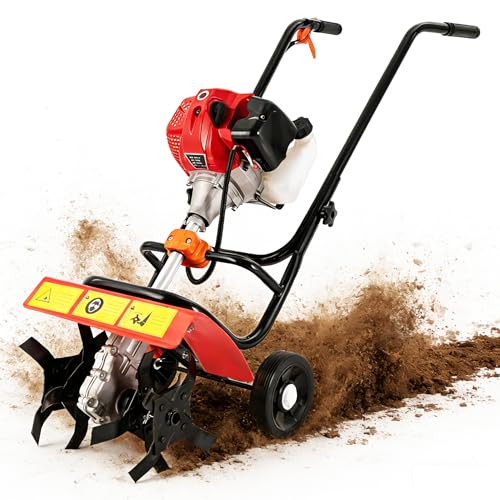
The EEYBLAEEY leans on ease of use, which is what most beginners actually want. EEYBLAEEY describes a hand-push, walk-behind design meant to give steady control without wrestling the machine. That simplicity is the pitch, and it is a fair one for someone tilling their first bed.
On paper it is the biggest engine here: a 52cc 2-cycle unit that the maker says handles breaking new ground and weeding. It uses 4 heat-treated steel tines and claims a roughly 14-inch working width with adjustable depth up to 4 inches. Its dimensions read 31.5 x 14.6 x 14.6 in, which is compact enough for a small garden.
The weakness is data. No weight is published, so you cannot judge how heavy the walk-behind push actually is, and it sells the slowest of the six. As a two-stroke it also needs fuel mixing, which trims the beginner-friendly claim a little.
Pros:
- Largest engine here at 52cc
- Simple walk-behind, hand-push design
- 14 in width claim covers ground quickly
- Four heat-treated steel tines
Cons:
- No published weight
- Two-stroke needs oil-fuel mixing
- The slowest seller of the six
- Only one seller lists it
6. SRTYGHW Gas Powered Garden Tiller — Best budget pick
The SRTYGHW is the budget pick because it is the cheapest of the six and covers basic tilling, as long as you accept minimal published specs.

Best for: occasional light tilling on a tight budget Skip it if: you want a four-stroke or a stated warranty
The SRTYGHW's clear advantage is price: it is the cheapest of the six. For occasional loosening and weeding, that entry point is the whole appeal. The maker lists a 43cc 2-cycle Viper engine with a claimed 1.25kW/1.7HP output at 8,500 RPM, and says the frame combines steel, an aluminum-alloy engine and gearbox, and a steel blade.
Adjustability is a plus. SRTYGHW states the wheel height adjusts across roughly 0 to 3.94 in, and the depth range runs 1.97 to 3.94 in via the wheel setting. It uses a manual recoil start, and its 43.2 x 12.6 x 10.6 in dimensions describe a slim tiller.
The trade-offs are the honest cost of the low price. No weight and no warranty are published, and its depth tops out at a claimed 3.94 in. It is a two-stroke, so fuel mixing is part of the deal. Treat it as a light-duty machine, not a clay-breaker.
Pros:
- The cheapest of the six
- Adjustable wheel height, roughly 0 to 3.94 in
- Slim 12.6 in wide footprint
- Simple manual recoil start
Cons:
- No published weight or warranty
- Shallow depth claim of 3.94 in
- Two-stroke fuel mixing required
- Only one seller lists it
Two-stroke or four-stroke: which should you buy?
This is the fork in the road for a gas mini tiller, so decide it first.
- Four-stroke (Honda FG110, BILT HARD 46cc): runs on straight gas, no mixing. Honda says the GX25 is built for quick starts. Fewer steps at the pump and at fill-up.
- Two-stroke (VEVOR, NuBusno, EEYBLAEEY, SRTYGHW): lighter for its power, but every fill needs the correct oil-fuel ratio. Get the mix wrong and the engine suffers.
If you have never mixed two-stroke fuel and do not want to start, buy one of the four-strokes. The Honda is the compact choice, the BILT HARD the wider one.
If you are comfortable measuring oil into gas, the two-strokes open up cheaper options and, in the VEVOR's case, a heat-management focus for longer runs. There is no single right answer here. There is only the answer that matches how much fuss you will tolerate at the gas can.
How wide and deep do these really go?
Width and depth decide whether a tiller fits your beds, so line up the numbers before you buy. Remember that most of these figures are manufacturer claims, not standardized tests.
Widths, narrowest to widest:
- Honda FG110: 9 in, narrowing to 6 in with outer tines removed
- SRTYGHW: 9 in claim
- NuBusno: 9.8 in claim
- VEVOR: 11.8 in claim
- EEYBLAEEY: 14 in claim
- BILT HARD: 16 in claim
On depth, the BILT HARD's 8-inch claim leads, the Honda works a controllable depth via its adjustable bar, and the two-stroke budget models cluster near 3.9 to 4 inches. That shallow depth is fine for loosening worked soil and weeding. It is less suited to breaking hard new ground.
The takeaway: wider is not automatically better. A 16-inch cut is faster in the open but clumsy between plants. A 9-inch cut, or the Honda's 6-inch narrowed setting, is what threads a raised bed without chewing your seedlings.
When a different pick wins
The Honda is the default, but a few clear conditions flip that.
- If your storage is tight and your beds are narrow, the NuBusno wins. At 28.7 lb with a 9.8-inch width, it is the compact two-stroke built for flower beds.
- If you want the widest possible cut without mixing fuel, the BILT HARD wins. Its 16-inch claim and four-stroke engine cover open ground fast, provided you have room to store a 42.9-inch machine.
- If you plan long, continuous sessions, the VEVOR wins. Its listing is built around heat dissipation and continuous operation, and its published 33.1 lb weight tells you exactly what you are moving.
- If price is the whole decision, the SRTYGHW wins as the cheapest of the six, with the caveat that you accept minimal published specs and a two-stroke fuel mix.
Match the pick to the bed and the budget, not to the biggest engine number.
The verdict
For an entry-tier budget, the SRTYGHW is the cheapest way into a gas mini tiller, with a 43cc two-stroke and a slim 12.6-inch footprint. Accept the missing weight and warranty and it will handle light tilling.
In the middle, the NuBusno and VEVOR split by job. The NuBusno, at 28.7 lb with a 9.8-inch width, is the small-space choice. The VEVOR, at 33.1 lb with a heat-dissipation focus, is the one for longer sessions. Both are two-strokes, so budget for fuel mixing.
At the premium end, the best gas mini tiller overall is the Honda FG110. It is the pick I would start with for most backyard gardeners: a 28 lb four-stroke that runs on straight gas, tills 9 inches wide, narrows to 6 for tight beds, and carries the only stated warranty here, a 2-Year Residential Warranty. The BILT HARD is the premium runner-up, and its exact advantage is reach: a claimed 16-inch width and 8-inch depth for open ground, if you can store the largest machine in the group.
FAQ
Is a gas mini tiller worth it over an electric one?
A gas mini tiller is worth it when you need cordless reach and steady power away from an outlet. All six here run on gasoline, so there is no cord to drag and no battery to recharge mid-row. The trade-off is fuel and, on four picks, the two-stroke oil-fuel mix. For larger or remote plots, that freedom usually earns its keep.
What is the best value gas mini tiller here?
The best value gas mini tiller depends on your budget line. The SRTYGHW is the cheapest of the six and covers light tilling. But the Honda FG110 delivers the most for its premium price: a four-stroke engine, a compact 28 lb body, an adjustable 9-to-6-inch width, and the only 2-Year Residential Warranty in the set. Value is what you plan to till, not just the sticker.
How wide and deep can these tillers actually go?
How wide and deep varies a lot across this group. Widths run from the Honda's 9 inches, narrowing to 6, up to the BILT HARD's claimed 16 inches. Depths span the budget two-strokes near a claimed 3.9 to 4 inches to the BILT HARD's claimed 8 inches. Most of these are manufacturer figures, so treat them as the maker's claims rather than tested numbers.
Honda FG110 or BILT HARD 46cc: which should I pick?
Between the Honda FG110 or BILT HARD, choose by beds and storage. Both are four-strokes, so neither needs fuel mixing. The Honda is compact at 28 lb, tills 9 inches wide, narrows to 6, and carries a 2-year warranty. The BILT HARD claims a wider 16-inch cut and 8-inch depth but is the largest machine here at 42.9 inches long, with no published weight.
What is the biggest mistake buying a gas mini tiller?
The biggest mistake is chasing engine displacement alone. A 52cc number looks stronger than 25cc, but engine type and working width decide real performance. A big two-stroke still needs fuel mixing, and a 16-inch cut fights you in narrow rows. Check whether the tiller matches your beds and your willingness to mix fuel before you look at the cc figure.
Start by answering two questions: do you want to mix fuel, and how wide are your beds. If the answers are "no" and "narrow", the Honda FG110 is the natural default, and it is the pick I would hand to most backyard gardeners without a second thought. It is the compact four-stroke that runs on straight gas, adjusts its width for tight rows, and backs itself with the only warranty in the group. Match the machine to your beds first, then check the current price on the pick that fits.