Best Counter Rotating Rear Tine Tiller for Hard Clay

Five counter rotating rear tine tillers compared on width, depth, weight and warranty, with the Earthquake Victory 39381 as the pick for hard, unbroken ground.

By Dane JonesUpdated 14 min read
On this page
- Best counter rotating rear tine tiller at a glance
- How I screened the field down to five
- 1. Earthquake Victory 39381 — Best overall
- 2. NOVUS 18-Inch Dual Direction — Best premium
- 3. NOVUS 17-Inch Dual Direction — Best minimal setup
- 4. SuperHandy GUO116 — Best budget pick
- 5. YARDMAX YT4565 — Best for pros
- What counter-rotation actually does in the ground
- Width, depth and weight: what the numbers mean
- Is a counter rotating rear tine tiller worth it for you?
- What the listings do not tell you
- The verdict
- FAQ
The best counter rotating rear tine tiller for hard clay and unbroken ground is the Earthquake Victory 39381, a 154 lb machine with a 209cc Viper engine, a 16-inch cut up to 10 inches deep and a 5-year limited warranty on the frame. If you want dual-direction tines with airless tires, the NOVUS 18-inch is the alternative, wider at 18 inches and rated to the same 10-inch depth.
Best counter rotating rear tine tiller at a glance
| Pick | Width & depth | Weight | Price |
|---|---|---|---|
Best overall Earthquake Victory 39381 |
16 in wide 10 in deep |
154 lb | Check Price |
Best premium NOVUS 18-inch Dual Direction |
18 in wide 10 in deep (claim) |
Not listed | Check Price |
Best minimal setup NOVUS 17-inch Dual Direction |
17 in wide 8 in deep (claim) |
175 lb | Check Price |
Best budget pick SuperHandy GUO116 |
16 in wide 12 in deep (claim) |
Not listed | Check Price |
Best for pros YARDMAX YT4565 |
18 in wide (claim) Depth not listed |
208.5 lb | Check Price |

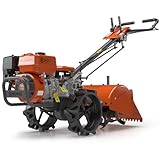


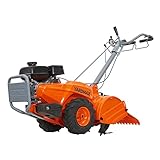
Most guides to the best counter rotating rear tine tiller compare horsepower first. That is the wrong lead. All five machines here run a 209cc or 212cc single-cylinder gas engine, so the engine is not what splits them. The real deciding specification is what the transmission and the frame do with that power: how the tines are geared, whether they can reverse, and how much mass sits behind them when they hit hard ground.
How I screened the field down to five
I started with every rear tine tiller listed under Outdoor Power Tools that advertises counter-rotating tines, then cut anything without a published tilling width, a published engine size, or a clear description of tine direction. The five that survived all run four-stroke gas engines between 209cc and 212cc, and each one either runs CRT permanently or offers a dual-direction mode that includes it.
- Dropped for missing width and depth figures on the listing
- Dropped for belt-only drive without a gear transmission spec
- Dropped for being sold as front-tine machines mislabelled as rear
- Kept only if the listing named CRT or dual-direction operation explicitly
That leaves one clear entry-price machine, one mid-priced workhorse, two premium dual-direction units, and one true budget option. Every pick below is judged against the other four, not against tillers that never made the shortlist.
1. Earthquake Victory 39381 — Best overall
The Victory is the pick when your soil has not been worked in years and you want a warranty long enough to matter.
Best for: breaking new ground and hard clay on a home plot Skip it if: you want a machine that also tills already-worked beds gently
The Victory is the lightest of the four picks with a published weight, at 154 lb, which sounds like a weakness on a rear tine tiller and is not. It is enough mass to keep the counter-rotating tines biting without turning transport into a two-person job. Earthquake states the tines cut a row 16 inches wide and up to 10 inches deep, driven by a 209cc four-cycle Viper engine through a cast-iron transmission with bronze gears. The frame carries a 5-year limited warranty, the longest published figure in this set.
Two features earn their place in the pitch: an Instant Reverse handle that lets you turn near a fence without shifting, and a three-position adjustable handlebar. The trade-off against the wider NOVUS pick is a narrower 16-inch path, so a long row takes one more pass. Against the YARDMAX, you give up roughly 55 lb of mass and gain a machine you can actually wheel to the shed alone.
Pros:
- Longest published warranty in this set at 5 years
- Cast-iron transmission with bronze gears named on the listing
- Instant Reverse for tight turns without gear changes
- Lightest of the four picks with a published weight
- Sells faster than the rest of this shortlist
Cons:
- 16-inch path is narrower than either NOVUS 18-inch or YARDMAX
- Pneumatic wheels can go flat, unlike the airless NOVUS 18-inch
- Only one seller lists it, so stock is thin
2. NOVUS 18-Inch Dual Direction — Best premium
The NOVUS 18-inch is the pick when you want the widest cut and tires that cannot puncture.
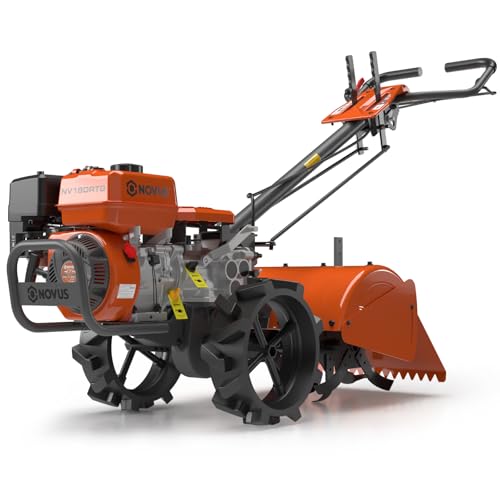
Best for: gardeners who want dual-direction tines and airless tires Skip it if: published weight and warranty figures matter to you
This is the most expensive pick here, and the specification that justifies it is the 18-inch tilling width paired with airless tires. NOVUS says the 212cc four-cycle engine drives a full gear transmission rather than a belt, and that the 16 steel tines will run forward or in counter-rotation depending on what the ground needs. The listing claims up to a 10-inch tilling depth, matching the Earthquake on paper, over a path that is two inches wider.
Two forward speeds and one reverse give it more transmission range than the second NOVUS, and the airless tires remove one failure mode that pneumatic wheels bring. What is missing is what makes this a considered buy rather than an obvious one: no weight and no warranty appear on the listing. The Earthquake publishes both. If the extra two inches of cut and the airless tires solve a real problem for your plot, the NOVUS earns the premium; if they do not, the Victory is the safer document.
Pros:
- Widest tilling path in this set at 18 inches
- Airless tires cannot go flat
- Full gear transmission named on the listing
- Two forward speeds plus reverse
- Runs forward or counter-rotating on demand
Cons:
- The most expensive pick here
- No weight or warranty published on the listing
- Slowest seller of the five
3. NOVUS 17-Inch Dual Direction — Best minimal setup
The 17-inch NOVUS is the pick if you want independent drive and tine controls, and you accept a shallower bite.

Best for: buyers who want independent drive and tine controls out of the box Skip it if: you need the deepest possible bite in one pass
This NOVUS is a distinct machine from the 18-inch, not a variant of it. It publishes a 175 lb weight, a 2-year warranty, model NV17DRTG and dimensions of 20 x 61 x 45 in. The listed tilling width is 17 inches, and NOVUS claims up to an 8-inch tilling depth, which is the shallowest published figure among the picks. The 212cc four-cycle engine matches the 18-inch, but the transmission is described as one forward, one neutral, one reverse.
What sets this one apart is separate control of wheel drive and tine operation. That means you can move the machine without spinning the tines, useful when repositioning between beds or across a gravel path. Sixteen heavy-duty steel tines and an adjustable handlebar round out the setup. The trade-off is a shallower cut than either the Earthquake at 10 inches or the SuperHandy's 12-inch claim, so on ground that needs a deep pass, this is not the answer.
Pros:
- Independent wheel and tine control
- Published weight, warranty and model number on the listing
- 212cc four-cycle engine matches the 18-inch NOVUS
- Adjustable handlebar for operator height
Cons:
- Shallowest depth claim in this set at 8 inches
- 2-year warranty is less than half the Earthquake's 5 years
- Heaviest orange machine here at 175 lb
- Second-highest price position
4. SuperHandy GUO116 — Best budget pick
The SuperHandy is the pick when the shopping constraint is price and the plot needs a deep pass.

Best for: shoppers chasing the lowest price on a 16-inch CRT machine Skip it if: you want a published warranty or engine displacement in cc
This is the cheapest of the five, and the specification it leads with is depth. SuperHandy describes a 7HP engine, a 16-inch tilling width and a 12-inch tilling depth, which is the deepest figure on any listing in this set. The tines are hardened steel and turn counter to the self-propelled wheels, and the machine rolls on 13-inch agricultural inflatable tires. Three height-adjustable handles and an adjustable depth stake sit on top.
The catch is what the listing leaves out. There is no engine displacement in cc, no weight, and no warranty period, where the Earthquake publishes all three. That does not mean the machine is worse, but it does mean the buyer is trusting fewer figures. Against the Earthquake, you save at the till and gain a claimed 2 inches of depth; against either NOVUS, you give up dual-direction tines and the airless tire option. Buy this one if the budget line is fixed and you want a deep pass.
Pros:
- Cheapest of the five picks
- Deepest depth claim at 12 inches
- 13-inch agricultural tires named on the listing
- Three height-adjustable handles
Cons:
- No warranty published on the listing
- Engine given as 7HP with no cc figure
- No published weight
- Pneumatic tires can puncture
5. YARDMAX YT4565 — Best for pros
The YARDMAX is the pick when the plot is large enough that mass is a feature, not a burden.

Best for: larger plots where mass and an 18-inch path do the work Skip it if: you have to lift, load or wheel it up a ramp alone
At 208.5 lb the YARDMAX is the heaviest machine in the shortlist, more than 54 lb over the Earthquake and 33 lb over the 17-inch NOVUS. On broken ground that mass is doing something for you: it plants the tines and keeps them in the soil rather than skipping across the crust. The listing shows dimensions of 45 x 63 x 21 in and a 212cc OHV gas engine driving dual-rotating tilling, so counter-rotation is one of the modes rather than the only mode.
YARDMAX also notes on the listing that engine displacement may be either 209cc or 212cc depending on production timing, which is unusual honesty and worth reading. The trade-off is set out in the "skip it if" line. This is not the machine you wheel out for a raised bed. It is the machine you bring to a rural plot where the row is long and the ground has been left alone. Loading it into a pickup is a two-person job.
Pros:
- Heaviest pick at 208.5 lb for a settled cut
- 212cc OHV engine with dual-rotating tilling
- Listing declares engine variance openly
- Model in production since 2017
Cons:
- No published warranty or tilling depth figure
- Heaviest machine to move, load or store
- No named transmission type on the listing
- Sales rank is well behind the Earthquake
What counter-rotation actually does in the ground
Counter-rotating tines turn the opposite way to the drive wheels. That is the whole mechanical trick, and it changes the machine's job in one specific way: the tines lift and chop the soil rather than being pulled across the top of it. A forward-rotating tine tries to climb out of the ground when it hits a root or a rock, which is why forward-tine machines wander on hard clay. A CRT machine pulls itself down instead.
That matters more than horsepower in this category. All five picks run a 209cc or 212cc single-cylinder gas engine, so the engine is not what separates them.
- On unbroken ground, CRT lets a smaller engine bite in
- On worked soil, dual-direction machines can switch to forward rotation to avoid over-tilling
- On rocky ground, CRT still walks less than forward-tine machines
- On sandy loam, CRT is overkill and forward rotation is faster
Read the modifier in the keyword carefully. Not every listing here is CRT-only. The two NOVUS machines and the YARDMAX are dual-direction, meaning they run forward or in counter-rotation on demand. The Earthquake and the SuperHandy list counter-rotating operation as the mode. Match that to your ground before you match anything else.
Width, depth and weight: what the numbers mean
Three specifications actually decide how a session goes: how wide the cut is, how deep the tines reach, and how much the machine weighs. Everything else is downstream. Here is how the five picks line up on published figures.
- Widest cut: NOVUS 18-inch and YARDMAX at 18 in, then NOVUS 17-inch at 17 in, then Earthquake and SuperHandy at 16 in
- Deepest bite (as claimed): SuperHandy at 12 in, Earthquake and NOVUS 18-inch at 10 in, NOVUS 17-inch at 8 in, YARDMAX not published
- Heaviest frame: YARDMAX at 208.5 lb, NOVUS 17-inch at 175 lb, Earthquake at 154 lb, other two not published
A wider cut sounds like a straight win and is not, because a wider tiller wants a longer, straighter row. In a small kitchen garden with beds under 20 feet long, an 18-inch machine spends more time turning than tilling. Depth is where CRT earns its keep: the deeper the bite, the more chopping the tines are doing in one pass, and the fewer passes you need on hard ground. Weight determines whether you can wheel the machine solo and load it into a vehicle without a ramp and a friend.
Is a counter rotating rear tine tiller worth it for you?
Counter rotating rear tine tillers are the right tool for one specific job: breaking ground that has not been worked in years, or working heavy clay that stalls a forward-tine machine. If your plot has been tilled every spring for the last decade and drains well, a lighter forward-tine machine will do the same job with less fuel and less noise. The premium for CRT is real, and it is paid in weight, price and complexity.
Ask three questions before spending on this category:
- Has the soil been broken in the last two seasons?
- Is the plot longer than 20 feet in at least one direction?
- Can you store and move a machine over 150 lb?
Two "no" answers point you to a lighter tool. Three "yes" answers make CRT worth it, and the Earthquake Victory is the default from there. If any of those answers are borderline, one of the dual-direction NOVUS machines gives you the option to switch modes as the soil improves over seasons.
What the listings do not tell you
Product listings are marketing copy, and there are three details a shopper needs that the pages here mostly omit. Read these into every quoted specification.
- Assembly. Rear tine tillers ship partly assembled. Handlebars, wheels and depth stakes come off for the box. Budget an hour and a wrench set.
- Fuel. Every pick runs on gasoline through a four-cycle engine, so there is no oil to mix into the fuel, but the crankcase takes engine oil separately. Check the manual before the first pull.
- Noise and vibration. Single-cylinder gas engines are loud and shake the handlebars. None of these listings publish a decibel figure, and none of the picks are quiet.
Two other omissions to watch. Only the Earthquake and one NOVUS publish a warranty, so the SuperHandy, the YARDMAX and the 18-inch NOVUS are effectively warranty-unknown until you contact the seller. And only one seller lists each of these machines, so if the listing goes dark, there is no second source to fall back on inside Amazon.
The verdict
The Earthquake Victory 39381 is the best counter rotating rear tine tiller in this shortlist for a home gardener breaking hard ground. It is the lightest machine with a published weight, at 154 lb, it publishes the longest warranty in the set at 5 years, it names its transmission as cast-iron with bronze gears, and its 16-inch cut at up to 10 inches deep is enough for a plot most buyers will actually work. It sells faster than any other pick here, which is a market signal, not a review claim.
The NOVUS 18-inch Dual Direction is the runner-up on one specific advantage: 18 inches of cut with airless tires and a full gear transmission. If your rows are long enough that the extra 2 inches of width saves you a pass, and if the risk of a flat pneumatic tire is a real cost on your plot, the NOVUS earns the premium. On any other plot, the Earthquake's published warranty and lower price close the case.
FAQ
Is a counter rotating rear tine tiller worth it over a forward-tine machine?
A counter rotating rear tine tiller is worth it when the ground is unbroken, compacted clay or new to cultivation. CRT tines lift and chop rather than climbing out of the soil, so they bite in where forward tines skip. On soil that has been worked every spring and drains freely, a lighter forward-tine machine does the same job faster and cheaper.
What tilling width should I choose for a small home garden?
Tilling width should track the length of your rows. Under 20 feet, 16 inches is the sensible cut, so the Earthquake Victory or the SuperHandy fits. From 20 to 40 feet, 17 or 18 inches saves a pass per row without adding much bulk. Over 40 feet, the 18-inch NOVUS or the YARDMAX earns the extra width outright.
How deep can the best counter rotating rear tine tiller actually go?
The best counter rotating rear tine tiller depths in this set run from 8 to 12 inches on paper. The SuperHandy claims 12 inches, the Earthquake and NOVUS 18-inch each claim 10 inches, and the NOVUS 17-inch claims 8 inches. Real depth depends on soil condition, tine sharpness and how long you dwell on the pass, so treat the figures as ceilings.
Earthquake Victory 39381 or NOVUS 18-inch: which wins?
Earthquake Victory 39381 wins on published warranty and weight, at 5 years and 154 lb, and on price position. The NOVUS 18-inch wins on cutting width at 18 inches and on airless tires that cannot go flat. Choose the Earthquake for shorter rows and documented backing; choose the NOVUS for long, straight rows on a plot where a flat tire would matter.
What is the biggest mistake buying a rear tine tiller?
The biggest mistake is buying more machine than the plot needs. A 200 lb tiller with an 18-inch cut is the wrong tool for a 15-foot raised bed, no matter how impressive the specifications read. Match the tilling width to the row length and the weight to your ability to store and move the machine solo. Everything else follows from those two calls.
Start by measuring your longest row and weighing what you can move alone up a ramp. Those two numbers point at one machine on this list. For most home gardeners breaking clay or new ground, the pointer lands on the Earthquake Victory 39381, and its 5-year limited warranty carries the buy through more seasons than any other listing here documents. If your plot is longer or your ground is heavier than that, the NOVUS 18-inch is the honest step up. If your budget is fixed, the SuperHandy earns the shortlist on depth. Pick on rows and weight, not on horsepower, and the rest of the decision writes itself.